Is SpinKing Legit? Trust, Ownership and Safety Signals for Australia
 Available in US
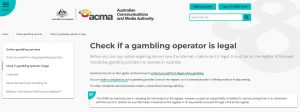
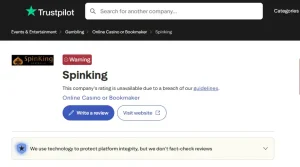
SpinKing does not fit a useful one-word “legit” or “scam” label. A current ACMA register check on 10 September 2026 found no SpinKing or spinking.net entry, so no Australian local licence was verified. Separately, Casino Guru currently gives SpinKing a 2.5/10 “Very low” Safety Index and flags concerns including missing public General Terms and Conditions, fake-game history and licence claims that it labels fake. Trustpilot currently makes the spinking.net rating unavailable because of a guideline breach and says it removed fake reviews.
Those are three different evidence types. The ACMA register is primary Australian regulatory evidence. Casino Guru is an attributed expert-review source. Trustpilot’s warning is a platform-integrity signal. Individual user complaints are allegations about particular experiences, not proof that every account will have the same outcome. The strongest assessment therefore comes from separating these layers instead of averaging them into a single verdict.
Table of Contents
- SpinKing trust scorecard
- Start with primary regulatory evidence
- What Casino Guru’s 2.5/10 rating does and does not prove
- Missing public General T&Cs are a transparency problem
- Trustpilot’s warning is about the review environment
- Why individual complaints stay allegations
- Ownership and operator identity require a higher threshold
- How to weight the signals
- A practical source-quality checklist
- So, is SpinKing legit?
- Trust questions answered
- Is SpinKing Legit? Trust, Ownership and Safety Signals for Australia
SpinKing trust scorecard
| Evidence layer | Current signal | Confidence | What it actually means |
|---|---|---|---|
| Australian regulator | No SpinKing/spinking.net match in the ACMA licensed-provider register checked 10 September 2026 | High for local licence status | No Australian local licence was verified. This does not identify or validate any foreign licence. |
| Expert casino review | Casino Guru Safety Index 2.5/10, “Very low”, updated June 2026 | Medium, attribution required | Casino Guru’s own methodology rates the casino poorly. It is not a regulator finding. |
| Expert-review warnings | Casino Guru flags missing General T&Cs, fake-game history and fake displayed licence claims | Medium, attribution required | These are material warning signals from that reviewer and should not be restated as independent regulatory findings. |
| Review-platform integrity | Trustpilot rating unavailable due to a guideline breach; fake reviews removed | High for what Trustpilot displays | The profile’s review environment has an integrity warning. It does not establish which individual positive or negative story is true. |
| Ownership transparency | The source set used for this review does not contain an operator identity that meets the site’s publication threshold | Evidence limitation | Do not infer a company name from an unverified listing or badge. |
For the broad product overview, see the full SpinKing Australia guide. The rest of this page explains why the evidence hierarchy matters more than a synthetic score.
Start with primary regulatory evidence
The first question for an Australian reader is not whether a review site calls SpinKing safe. It is whether a local Australian licence can be verified. ACMA maintains the register of licensed interactive gambling providers used to check whether an online wagering service is licensed to operate in Australia. Searches of the current register for SpinKing and spinking.net produced no match on 10 September 2026.
That supports a narrow statement: no Australian local licence was verified. It does not prove what offshore entity operates the website, and it does not convert every licence badge or third-party jurisdiction claim into a regulator finding. It also should not be confused with the separate legal rule that Australia prohibits providers from offering online casino services to people in Australia.
The distinction is important because licensing claims often collapse several questions into one. A foreign licence, even if one were later verified, would not become an Australian licence. A missing ACMA entry does not by itself tell you whether a foreign licence exists. The dedicated SpinKing Australian licence page handles that legal and regulatory distinction in detail.
What Casino Guru’s 2.5/10 rating does and does not prove
Casino Guru’s current SpinKing review, updated June 2026, shows a Safety Index of 2.5/10 with the label “Very low”. That is a useful expert-review signal because the site explains that its index considers factors such as terms, complaints, blacklists and other review inputs. It should still be read as Casino Guru’s assessment, not as an official safety certification or enforcement decision.
The most important part is not the number alone. Casino Guru says it could not find publicly available General Terms and Conditions, lists “Fake games” and “Operates with a fake license” among negative factors, and marks PAGCOR and Curaçao entries as “Fake” on its licensing section. It also says SpinKing had previously been detected with fake games, while a more recent checked selection contained real games. Those details create a more nuanced signal than simply repeating “fake games” without context.
This page therefore attributes the warnings exactly to Casino Guru. It does not independently declare that every game on SpinKing is fake, that a criminal offence has occurred, or that a particular foreign regulator has made a finding. The SpinKing game catalogue explains the current provider and game evidence separately from these trust concerns.
Missing public General T&Cs are a transparency problem
Casino Guru’s review says it did not find public General Terms and Conditions for SpinKing and treated that absence as a major negative input in its Safety Index. The current spinking.net page did not provide sufficiently accessible primary text to independently resolve that concern. This means a verified current set of general terms cannot be presented here or used to settle disputes about account rules.
That matters because terms are where an operator normally defines account eligibility, bonus conditions, withdrawal rules, verification obligations and dispute procedures. Without current primary text available for verification, exact high-risk details are intentionally omitted elsewhere on the site rather than filled from generic casino assumptions.
For readers, the practical implication is about evidence quality. A marketing page or payment interface can show that a feature exists, but it is not a substitute for the contractual rules governing that feature. When a term affects money, verification or account closure, the strongest source is the current official term or account screen, not a copied summary.
Trustpilot’s warning is about the review environment
Trustpilot currently displays a warning on the spinking.net profile stating that the company’s rating is unavailable because of a breach of its guidelines. The page also says that Trustpilot removed a number of fake reviews. That is a direct platform-level fact about the profile and is relevant because it weakens the usefulness of simply quoting the star score or counting positive versus negative posts.
It does not mean every remaining review is false, and it does not mean every accusation is proven. Trustpilot itself treats reviews as the opinions of individual users. A single complaint can be important for identifying a pattern to investigate, but it cannot establish a universal payout rule, an account policy or a legal conclusion.
The dedicated SpinKing reviews and complaints page separates platform warnings, repeated complaint themes and operator replies. On this trust page, the key point is narrower: when a review platform itself flags integrity problems, the review corpus needs more careful weighting.
Why individual complaints stay allegations
SpinKing has visible negative user reports on Trustpilot involving deposits, withdrawals, account reviews and alleged balance or account problems. These can help show what issues users say they encountered. They cannot be converted into verified statements that SpinKing always withholds withdrawals, always closes winning accounts or applies a specific unpublished rule.
The same discipline applies in the other direction. Positive reviews that praise quick withdrawals or good service do not prove that every user will receive that outcome. The profile’s fake-review warning makes blanket conclusions from either side even less reliable.
When a complaint concerns a withdrawal, the most useful next step is to compare it with primary transaction evidence: the account status, cashier record, verification request, support transcript and current terms. The site’s SpinKing withdrawals guide explains which withdrawal facts are verified and which exact limits, fees or processing times remain unsupported.
Ownership and operator identity require a higher threshold
Trust analysis often goes wrong when a reviewer fills an ownership gap with the first company name found on an affiliate page. This site does not do that. The current source set does not include an operator identity that meets the publication threshold for a direct claim, so no company is presented here as the verified owner of SpinKing.
That is an evidence limitation, not proof that no operator exists. It simply means the available material is insufficient to name one responsibly. A current official terms page, corporate disclosure, regulator record or another appropriate primary source could change that position in a future update.
The same rule protects readers from false precision elsewhere. An account can be available without a verified corporate identity in this dataset, and a payment method can be supported without establishing licence status. The SpinKing registration page uses that same separation between observable account evidence and unsupported operator details.
How to weight the signals
A useful trust assessment gives more weight to sources that are authoritative for the question being asked. For Australian licence status and gambling law, ACMA and legislation are stronger than review sites. For what Trustpilot displays on a Trustpilot profile, Trustpilot is the primary source. For Casino Guru’s Safety Index and warnings, Casino Guru is the primary source for its own assessment, but not for an Australian legal conclusion.
The source hierarchy can be applied in five steps:
- Identify the exact question: licence, ownership, terms, game authenticity, payment process or user experience.
- Prefer a regulator or current official document when the question is legal, licensing or contractual.
- Use expert reviews for attributed analysis, not as substitutes for regulator findings.
- Use review-platform warnings to assess the integrity of the review environment.
- Treat individual reviews as reports that may justify investigation, not as universal facts.
This prevents double-counting. For example, a Casino Guru warning about a displayed licence and an ACMA no-hit are not two independent proofs of the same claim. They answer different questions: one is an expert review of what it observed, while the other is a check for an Australian local licence.
A practical source-quality checklist
| Question | Best evidence | Weak substitute to avoid |
|---|---|---|
| Is there an Australian licence? | Current ACMA register entry | Foreign badge, affiliate label or review-site claim |
| What rules govern the account? | Current official General T&Cs and account screens | Generic casino rules copied from another brand |
| What does Casino Guru think? | Current Casino Guru review and methodology | Unattributed repetition of its score |
| Is the Trustpilot profile clean? | Trustpilot’s current profile warning | Raw star average without the warning |
| Did one user have a payout problem? | Complaint plus transaction/account evidence | Assuming the complaint proves a universal policy |
| Who owns the brand? | Primary corporate, terms or regulator evidence | Unsourced operator names from affiliate listings |
Readers should also date-stamp high-freshness checks. The Australian legal framework is changing, and reputation pages can change when reviews are removed, warnings are updated or new primary terms become available.
So, is SpinKing legit?
The evidence supports a cautious, layered answer rather than a binary label. No Australian local licence was verified in the ACMA register on 10 September 2026. Casino Guru currently assigns a 2.5/10 “Very low” Safety Index and publishes significant warnings. Trustpilot currently carries a guideline-breach warning and says fake reviews were removed. The available source set also does not support publishing a verified operator identity.
Those signals are enough to justify increased scrutiny, especially around terms, licence claims, game authenticity and withdrawals. They are not a licence to turn every user allegation into fact or to make an unsupported claim that the casino is criminal, fraudulent, guaranteed unsafe or guaranteed not to pay.
The decision-useful approach is to verify each claim at the source level, keep Australian regulatory status separate from offshore branding, and avoid depositing or supplying documents on the strength of a badge, rating or isolated review alone.
Trust questions answered
Does SpinKing have an Australian licence?
No Australian local licence was verified. SpinKing and spinking.net were not found in the ACMA licensed-provider register checked on 10 September 2026.
What is SpinKing’s Casino Guru Safety Index?
Casino Guru currently shows 2.5/10 with the label “Very low”, based on its own review methodology. That score is an attributed expert-review rating, not an Australian regulator finding.
Why is SpinKing’s Trustpilot rating unavailable?
Trustpilot currently says the rating is unavailable due to a breach of its guidelines and says it removed a number of fake reviews.
Does Casino Guru say all SpinKing games are fake?
No. Casino Guru warns that fake games were detected previously and also states that a checked selection contained real games. The warning should be read in that full context.
Is a foreign casino licence the same as an Australian licence?
No. Australian licensed online wagering operates through Australian state or territory licences and the ACMA register. A foreign casino licence would not be an Australian licence.