Offshore Casinos for Australian Players: How to Assess
 Available in AU

A practical look at browser access, licensing limits, legal exposure and the terms that can shape offshore casino payments.
Table of Contents
- How Offshore Casino Play Reaches Australian Phones
- Casino Sites, Licences and the Limits of a Seal
- The “USA Offshore Casino” Label in an Australian Search
- What “Offshore Casino” Means Under Australian Law
- Offshore Gambling: Legal Exposure and the Missing Local Recourse
- Assessing Offshore Casinos in 2026 Without a Name-Based Verdict
- What a “Top” Offshore Casino Claim Can—and Cannot—Show
- Reading an Offshore Casino Directory Without Mistaking It for Protection
- No-Deposit Bonuses and the Arithmetic of the Small Print
- Crypto Deposits and Withdrawals: Speed Is Not the Whole Story
- Safety
How Offshore Casino Play Reaches Australian Phones
On an Australian phone, access to an offshore casino is more often a browser task than an app-store download. The distinction can sound small: both routes put a familiar-looking icon or page on a screen. But they rely on different things. A browser opens a website; a native app is installed as software; a Progressive Web App sits between those forms, keeping the website’s connection while borrowing some of an app’s appearance.
For many services aimed at Australian users, the mobile browser is the ordinary route. The site opens in the browser, and the account used there is generally the same one used on a desktop computer. There is no separate mobile identity to maintain merely because the screen is smaller. The phone becomes another window onto the same account.
That arrangement helps explain why searching an app store is rarely the beginning of the process. Casino apps are seldom listed on Google Play or Apple’s App Store in Australia, so browser access is the default. A mobile site can be saved as a bookmark, opened again from browser history, or simply reached by entering its address. The interface may be designed to resemble an app, but the distinction matters: a website displayed full-screen is not thereby native software.
A PWA makes that distinction more visible. It is a shortcut to a casino website that behaves on a phone much like a native app. If the site presents an installation or add-to-home-screen prompt, the user can tap it and confirm. The result is an icon on the device and a more app-like way to reopen the site. The underlying service, however, remains a website rather than a conventional app downloaded from an app store.
This middle ground suits a mobile culture accustomed to turning websites into icons. It also reflects the practical limits of distributing casino software through mainstream stores in Australia. The phone’s home screen can suggest that an app has arrived; the route by which it arrived tells a different story. A neat icon is not a change of category.
Best Casino Not on BetStop Australia: What to Know
Native apps are another matter. A genuine native app is software made for a phone’s operating system and installed as such. Where an offshore operator offers an app outside the familiar stores, installation may involve sideloading—obtaining and installing software through a route other than Google Play or Apple’s App Store. That route carries security risks, and the safety of the app depends on the operator. The polished appearance of an installation screen cannot settle that question.
The store distinction is especially important because not every casino-themed app offers real-money play. Social and free-play casino apps use virtual credits and are available directly through Google Play and Apple’s App Store in Australia. Their presence in a store does not make them equivalent to an offshore real-money service. The visual vocabulary may overlap—casino imagery, games, balances—but virtual credits and money deposited into an account are not the same thing.
That difference can be easy to miss on a small screen. App-store badges, home-screen icons and game-like interfaces all borrow the same ordinary language of mobile software. Yet access route and type of play remain separate questions. A free-play app can be downloaded from a store; an offshore site may instead open in a browser or offer a PWA shortcut. Neither the icon nor the interface alone explains what kind of service sits behind it.
Phones also impose their own conditions on web access. A browser depends on a working connection, available memory and a current-enough browser; background apps can compete for device resources. When a page stalls or fails to load, the cause may be the phone or connection rather than the account itself. That is a mundane distinction, but mobile screens make mundane failures look mysterious.
A VPN does not turn a blocked destination into an approved one. Using one to reach a blocked casino may lead to winnings being voided and an account closed. That is not a technical guarantee of access; it is a route that can create further account problems. And where an offshore casino refuses to pay, there is no Australian government body for a punter to approach for a payout complaint.
No Local Recourse
If an offshore casino refuses to pay winnings, there is no Australian government body available for a punter to approach for a payout complaint.
The device may make the journey feel ordinary: a tap, a saved icon, a page that fills the screen. The route remains consequential. Browser play, a PWA, a store-listed free-play app and a sideloaded native app are different ways of reaching different kinds of software. On a phone, they can look surprisingly alike. The resemblance is only cosmetic.
Casino Sites, Licences and the Limits of a Seal
A licensing badge can look like a compact answer to a complicated question. It names an authority, supplies a seal and gives a site the appearance of having been inspected. For an Australian punter, however, the badge speaks first about the jurisdiction named on it. It does not, by itself, settle what the site may offer in Australia, whether the site will accept a particular location, or what practical remedy exists if a dispute arises.
Curaçao, the Malta Gaming Authority (MGA) and Gibraltar are among the jurisdictions associated with casinos that accept Australian players. Their names are not interchangeable, and a licence issued in one place should not be read as a licence issued in another. Nor does the mere appearance of a regulator’s name establish that a particular operator currently holds the authorisation it claims. The distinction matters: a seal is a claim to examine, not a universal passport.
A regulator’s authority is bounded by its own legal system. Its rules may govern an operator’s conduct under that jurisdiction, while Australian restrictions remain a separate matter. A foreign licence cannot make an Australian-facing service locally authorised by implication. That is the central limit of the offshore casino licence: it may tell something about the operator’s stated regulatory home, but it does not erase the boundary between that home and Australia.
Pokies Open Near Me in Australia: Casino Hours
The badge also says less about day-to-day experience than its polished design suggests. It cannot guarantee that a site will handle a withdrawal promptly, interpret its terms fairly, or resolve every disagreement in the punter’s favour. Even a genuine licence is not a promise that every transaction will be smooth. A logo is a poor substitute for the actual terms and the operator’s stated procedures.
There is a further distinction between a regulator’s existence and a site’s relationship with it. A regulator’s name in a footer is not proof that the operator is listed, that the permission covers the service being offered, or that the details remain current. Those are separate claims. A careful reading checks what the site says the authorisation covers, which company is named, and whether the licensing information can be matched to the relevant regulator’s public records. A badge that cannot be connected to a clear operator and a recognisable authority offers little more than decoration.
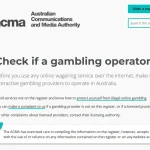
Australian access adds another layer. The Australian Communications and Media Authority (ACMA) works to restrict access to gambling sites that breach Australian rules. A site’s foreign licence does not prevent it from being blocked here; a blocked page is not evidence that a punter has simply entered the wrong web address. Access can change, and a site being reachable at one moment does not establish that it is permitted to serve Australians.
VPN Risks
Using a VPN to reach a blocked casino may breach the operator’s terms, potentially leading to voided winnings and account closure.
That is also why a VPN is not a neutral workaround. Using one to reach a blocked casino may breach the operator’s terms; winnings could be voided and the account closed. It can also obscure the location information on which account checks depend. A technical route around a block does not turn a foreign seal into Australian permission.
Before any deposit, the site must be checked for whether it accepts the punter’s actual location. That is not a box to infer from a licence badge or from a page that happens to load. If the site’s terms exclude Australia, the foreign regulator’s name does not reverse that exclusion. And when an offshore casino refuses to pay winnings, there is no Australian government body that can be approached to compel payment. The gap between a regulator’s seal and a local remedy is substantial.
Payment labels need the same restraint. A licensing badge cannot tell whether a chosen deposit method will work, what fees may apply, or whether the same route can be used for a withdrawal. Those details belong to the operator’s payment terms, which may distinguish deposits from cashouts. A successful deposit would prove only that a transaction went through—not that a later withdrawal is guaranteed.
Promotions sit outside the assurance offered by a licence badge, too. Before claiming a bonus, the full terms need to be read, including wagering requirements, game restrictions, expiry dates and cashout caps. A regulator’s name does not make those conditions disappear, and an attractive headline does not explain their effect.
The seal may be relevant evidence about an operator’s claimed jurisdiction. It is not a verdict on Australian availability, a promise of fair treatment, or a substitute for local protection. A limited assurance.
The “USA Offshore Casino” Label in an Australian Search
“USA” can describe the audience a casino is trying to reach, the market its pages discuss, or simply the wording used to attract attention. It does not, by itself, identify where a business is based, which rules apply to it, or whether its services are available in Australia. One small label, several different maps.
That ambiguity matters because casino pages often speak to imagined markets rather than the circumstances of every person who finds them. A site may use American spelling, refer to US customers or display prices in a currency familiar to them. None of those details settles whether Australians can register, whether the site accepts an Australian address, or what happens if a punter attempts to use it from Australia. The page’s language is not a passport.
The same distinction works in the other direction. A casino described as Australian-facing is not thereby Australian-operated or locally authorised. Casinos that accept Australian players may be associated with jurisdictions such as Curaçao, the Malta Gaming Authority or Gibraltar. Those place names identify different jurisdictions; they do not turn the phrase “USA offshore casino” into a reliable description of an Australian player’s options. A label can travel more easily than the service it names.
Curaçao Casino Licence for Australian Players
One phrase, several possible meanings
A US-facing description may point to a site’s intended readership, its marketing vocabulary, or a broad category used by whoever wrote the page. It may also be a loose geographic shorthand, with no clear statement about the operator’s actual location. Without specific, consistent information, the word “USA” does not resolve these possibilities.
Nor does the presence of American themes or references establish that a site is available to people in the United States, Australia, or any other country. Online businesses can write for an audience they do not serve. They can also use broad regional language that makes a page feel relevant before its terms reveal whom it actually accepts. Relevance is not access.
For Australians, “offshore” is itself relational: it means outside the local frame, not a single country or a uniform set of rules. An offshore crypto-friendly casino may describe itself through a jurisdiction, a payment preference or a target audience, but those descriptions answer different questions. The location of an operator, the intended market and the places where the site accepts customers should not be treated as interchangeable.
This is why an American-facing label should not be read as evidence that a casino is suitable for an Australian punter. A site may be written for one market while appearing in another person’s results; a site may mention Australia without accepting Australian residents. The decisive practical point is whether the operator explicitly accepts the player’s location. That needs to be confirmed before any deposit, not inferred from a headline or a familiar flag.
Availability is not a geographic guess
An Australian connection does not make a site’s claims clearer. ACMA actively blocks access to illegal gambling sites, so a page that appears in a browser does not prove that its service is available or permitted. A blocked page, an inaccessible page and a site that declines Australian registrations are different outcomes, but none can be explained simply by whether the site calls itself “USA” or “Australian.”
Using a VPN to get around a block is not a reliable solution. If a casino’s terms prohibit that access, winnings may be voided and the account closed. A change in apparent location does not change the underlying terms or guarantee that a withdrawal will be honoured.
The same caution applies to an app offered outside the official app stores. Sideloaded casino apps carry security risks, and their safety depends on the operator. An app’s American branding cannot establish that it is secure, authorised or intended for Australian use. A polished interface is an interface, not a geographic assurance.
There is also a practical absence behind the branding. If an offshore casino refuses to pay winnings, there is no Australian government body for the punter to approach to recover them. A page aimed at a US audience does not supply an Australian complaints channel; neither does an Australian flag in its marketing.
Legal Distinction
Under the Interactive Gambling Act 2001, the prohibition applies to the operator providing the service, not to the individual Australian player participating in it.
The central distinction is modest but useful: audience labels describe how a site presents itself, while acceptance terms describe whom it says it serves. Neither should be substituted for the other. For Australians, a US association does not establish local availability, and an Australian association does not establish local protection. The label is not the territory.
What “Offshore Casino” Means Under Australian Law
“Offshore casino” describes a service offered from outside Australia, but the label alone does not settle its legal position. The central distinction is between the business supplying online casino games and the person who might play them. Australian law treats those roles differently.
Under the Interactive Gambling Act 2001, an operator must not provide online casino-style games to people in Australia. The rule concerns the service being offered to people here; it is not made irrelevant by the operator’s location or by the name it gives its business. In legal terms, the important boundary is not simply where a company says it is based. It is whether the prohibited service is being supplied to users in Australia.
That distinction matters because “offshore” can sound like a complete explanation. It is not. The word describes a relationship to a national boundary, while the law asks a more specific question about the operator’s conduct. A service may be called foreign, international or offshore, but those descriptions do not turn the provision of online casino games to people in Australia into something the Act permits.
The same law does not make an individual Australian player’s act of playing at an offshore mobile casino illegal. That is a different legal position from the operator’s. The Act places the prohibition on the supply of the service, rather than making the player’s participation itself an offence under that law. The two sides of the transaction therefore cannot be collapsed into a single verdict about whether “offshore gambling” is legal.
This distinction is easy to lose in ordinary conversation. A person may say that an offshore casino is illegal, when the more precise statement is that an operator is prohibited from offering the relevant online games to people in Australia. Another may infer that, because a player is not committing an offence by playing, the service must be lawful to provide. That conclusion does not follow. The legal positions are separate, not mirror images.
The phrase “offshore casino” also does not name a special category that sits outside Australian law. It is a description of the service’s relationship to Australia, not a legal exemption. The law’s concern is the provision of online casino-style games to users in the country. Changing the commercial label does not alter that basic distinction.
Nor does the player’s lack of illegality amount to official approval of the operator. It simply means that the Act’s treatment of the individual player differs from its treatment of the business supplying the games. This is a narrow but important point: legality is not a single property shared by everyone involved in a transaction. One party can be prohibited from providing a service while the other is not prohibited from using it under the same Act.
The distinction is particularly useful when the word “legal” appears without a subject. Is the question about the operator’s offer, or the individual’s act of playing? Without that subject, the answer can sound broader than it is. For online casino-style games, the Act bars operators from serving people in Australia; playing at an offshore mobile casino is not itself illegal for an Australian player under that Act.
That is the basic legal frame. The word “offshore” identifies a location relationship; it does not decide the law. And the rule aimed at suppliers is not the same rule as one aimed at players. A small distinction, with large consequences for how the subject is described.
Offshore Gambling: Legal Exposure and the Missing Local Recourse
The practical risk of an offshore casino is not limited to whether its games load or an account can be opened. It also concerns what happens when a dispute arises in a market where the service itself is prohibited. Under the Interactive Gambling Act 2001, operators cannot provide real-money online casino games to people in Australia. Casino-style games such as poker, blackjack, roulette and pokies fall within that prohibition.
Highest Payout Online Casinos in Australia: Explained
That legal exposure sits primarily with the operator, not with an individual punter who plays offshore. Playing at an offshore casino is not, by itself, an offence for an Australian player under the Act. This distinction can be easy to lose in the blur of a blocked webpage and an ominous legal label: the law prohibits the service being supplied, rather than imposing a penalty on the person who tries to use it.
The distinction is not a guarantee of practical protection. A site operating beyond Australia may be difficult to hold to account through Australian processes, and a player whose withdrawal is refused has no Australian government body to approach for help recovering the money. There is no local public complaints office that can order an offshore casino to honour a disputed payment. The gap is consequential: permission to complain is not the same thing as a remedy.
ACMA’s role is different. The Australian Communications and Media Authority actively blocks access to illegal gambling sites, as part of enforcement against services offered contrary to the Act. A block is a regulatory measure; it is not a decision on an individual account dispute, and it does not return funds. The state can restrict access to a service without becoming the service’s customer-support department. A brisk separation.
That is why “offshore casino legal” has no single, reassuring answer when treated as a question about consequences. The operator’s provision of real-money casino games to people in Australia is prohibited. The individual player is not liable under this Act merely for playing. Yet if the operator withholds winnings, the absence of a local government body with authority to resolve that complaint remains a real limitation. The legal position and the practical ability to recover money are separate matters.
Access restrictions also matter. Using a VPN to reach a blocked casino may breach the operator’s own conditions; the account could be closed and winnings voided. A technical route around a block does not remove the underlying regulatory context or create a local route for resolving a dispute. It may simply add another point of disagreement between the account holder and the operator.
Age rules do not change that landscape. People must be at least 18 to register and gamble in Australia, but meeting that threshold does not turn a prohibited service into a locally protected one. The central consequence is plain: an offshore gambling casino can be reachable, yet remain outside the ordinary structures of Australian consumer recourse. Availability is not protection.
Assessing Offshore Casinos in 2026 Without a Name-Based Verdict
A name can make an offshore casino feel settled: selected, compared, perhaps safer by association. It settles nothing. A useful assessment begins with details that can be checked against the operator’s own current rules, and ends before a listing becomes an endorsement.
Location acceptance is the first practical test. An Australian punter should confirm that the site accepts people in their state or territory before depositing; an accessible page is not proof that registration or play is permitted by the operator’s terms. A VPN is no remedy for a blocked service: using one may breach those terms, void winnings or lead to account closure.
The first withdrawal is another revealing point. Casinos commonly require identity checks before releasing funds, and the first request may involve a selfie or identity document alongside proof of address. That can turn an apparently simple balance into a request for personal records. The process, accepted documents and relevant withdrawal conditions belong in the terms, not in assumptions formed at registration.
Bonuses require their own close reading. Wagering requirements, game restrictions, expiry dates and cashout caps can change what an offer is worth, or whether it can be used at all. The attractive headline is the least informative part.
Any operator entries elsewhere on the page are offshore, crypto-friendly listings, not evidence of Australian approval or a promise of protection. Australia’s rules prohibit operators from providing real-money online casino games to people in the country, while individual players are not made liable under the Interactive Gambling Act for playing offshore. The distinction does not create a local complaints route: no Australian government body can be approached to compel an offshore casino to pay winnings.
A ranking is not a safeguard. What is written in the terms matters; what can be enforced locally matters more.
What a “Top” Offshore Casino Claim Can—and Cannot—Show
Choosing an offshore casino as an Australian player calls for attention to practical details such as licensing, payment timing and minimum deposits. Use this list as a reference when deciding which operators to investigate further.
1. MrPacho
Payout speed: crypto 30-120 minutes, fiat 24-72 hours · Min. deposit: A$30
MrPacho lists crypto payouts at 30–120 minutes and fiat payouts at 24–72 hours. The minimum deposit is A$30.
2. Rollero Casino
License: Curacao Gaming Control Board OGL/2023/176/0095 (Hollycorn N.V.)
Rollero Casino lists a Curacao Gaming Control Board licence, OGL/2023/176/0095, held by Hollycorn N.V.
3. Neospin
License: Curacao Gaming Control Board OGL/2023/176/0095 (Hollycorn N.V.)
Neospin lists a Curacao Gaming Control Board licence, OGL/2023/176/0095, held by Hollycorn N.V.
4. LevelUp Casino
License: Curacao eGaming OGL/2023/174/0082 (Dama N.V.) · Min. deposit: A$15
LevelUp Casino lists a Curacao eGaming licence, OGL/2023/174/0082, held by Dama N.V. Its minimum deposit is A$15.
5. SkyCrown
License: Tobique Gaming Commission · Payout speed: crypto ~10-15 minutes, fiat 1-5 days · Min. deposit: A$30
SkyCrown lists a Tobique Gaming Commission licence. Its stated payout times are around 10–15 minutes for crypto and 1–5 days for fiat, with a minimum deposit of A$30.
6. SpinsUp
License: Curacao Gaming Control Board OGL/2023/174/0082 (Dama N.V.)
SpinsUp lists a Curacao Gaming Control Board licence, OGL/2023/174/0082, held by Dama N.V.
7. Vegaz Casino
License: Curacao OGL/2024/1335/0780 · Min. deposit: EUR 20
Vegaz Casino lists a Curacao licence, OGL/2024/1335/0780. Its minimum deposit is EUR 20.
8. Kingmaker
Payout speed: crypto ~90 minutes, fiat 1-5 days · Min. deposit: A$30
Kingmaker lists crypto payouts at around 90 minutes and fiat payouts at 1–5 days. The minimum deposit is A$30.
9. WinSpirit Casino
License: Curacao eGaming OGL/2024/923/0383 (Antillephone N.V.) · Min. deposit: A$30
WinSpirit Casino lists a Curacao eGaming licence, OGL/2024/923/0383, held by Antillephone N.V. Its minimum deposit is A$30.
10. Uptown Pokies
License: Curacao (operating since 2017) · Min. deposit: A$20
Uptown Pokies lists a Curacao licence and has been operating since 2017. Its minimum deposit is A$20.
“Top” is a verdict with its measurements hidden. A headline may imply that a casino pays reliably, yet say nothing about how much can be withdrawn at once, how often a limit resets, or whether the advertised payment route can carry money back out. Those details can matter more than the glow of a ranking.
A specialist review reports that some casinos set weekly or monthly withdrawal ceilings, with figures often described in the range of $4,000–$10,000 per week. That is not a universal term or a promise that a particular punter can withdraw that amount. The operator’s own current rules determine what applies, and the wording should be checked for separate limits by account status, payment method or other conditions.
The route in may not be the route out. Some casinos require a withdrawal through the same method used for a deposit; other methods are deposit-only, according to a specialist review. A payment option displayed at the cashier therefore does not, by itself, establish that it can receive winnings. A headline cannot settle that question.
Do
- Check if the site explicitly accepts your actual location
- Read the full terms for withdrawal limits and methods
Don’t
- Rely on a “top” ranking as a guarantee of reliability
- Use a VPN to bypass blocks without checking the terms
Nor does “top” mean suitable for an Australian address. Before depositing, the site must be checked for whether it accepts that location. Using a VPN to reach a blocked casino may void winnings and lead to account closure. If an offshore casino refuses payment, there is no Australian government body to complain to on the punter’s behalf.
The phrase “offshore crypto-friendly casino” describes a category, not a quality guarantee. A ranking can draw attention to a claim; it cannot replace the terms governing withdrawals or create local protection. In Australia, real-money online casino services are prohibited for operators, so this is not an endorsement or an invitation to play. The headline proves little. The fine print decides more.
Reading an Offshore Casino Directory Without Mistaking It for Protection
A directory of offshore casinos is a comparison tool, not a certificate. It can gather claims about payment options, account access and site features in one place, but a neat table does not establish that those details are current, that a site will accept someone in Australia, or that an official body endorses it. Presentation is not protection.
The distinction matters because an offshore crypto-friendly casino may describe its services in polished, familiar language while setting its own conditions behind the page. A listing can help organise what a site says; it cannot turn that statement into an independent guarantee. The ranking elsewhere on this page should be read in the same spirit: as comparison, not assurance.
Availability is a separate question. Before depositing, a punter must confirm that the site accepts their location. A specialist review has reported that some Australian banks block or flag gambling-related card charges, so a card deposit may fail even when a site lists that method. Payment logos do not settle the matter.
Nor does a directory make access safer by way of a workaround. Using a VPN to reach a blocked casino may void winnings and lead to account closure. Sideloaded casino apps carry security risks, and their safety depends on the operator; a listing alone cannot resolve them.
There is also a limit no directory can repair: if an offshore casino refuses to pay winnings, there is no Australian government body to complain to. A polished profile cannot supply that missing local recourse.
Promotional details need their own scrutiny. Before claiming a bonus, the terms should be read for wagering requirements, game restrictions, expiry dates and cashout caps. Those conditions belong to the offer, not to the directory’s reassuring layout.
Before Depositing
- Confirm the operator accepts residents of your state or territory
- Check if your bank blocks or flags gambling-related card charges
- Verify the specific withdrawal methods available for your account
- Review the identity documents required for the first KYC check
A list can organise claims. It cannot make them protection.
No-Deposit Bonuses and the Arithmetic of the Small Print
A no-deposit offer sounds like a gift because its first condition appears to be the absence of one. The rest of the terms may tell a different story. A bonus can be available without an initial payment while still requiring substantial wagering before any winnings become withdrawable. “Free” describes the entry point, not necessarily the route out.
A specialist affiliate review describes welcome-bonus wagering requirements in the range of 30x to 50x the bonus amount, and treats requirements above 40x as steep. Those figures are a guide to how demanding the arithmetic can be, not a guarantee that a particular offer uses those terms. The calculation may also apply to the bonus alone or to the bonus and deposit together; the wording matters.
Other conditions change the practical value. A minimum deposit may be required to activate or release an offer. Game restrictions can mean that some play contributes little or nothing towards wagering. An expiry date sets the time available to meet the conditions, while a cashout cap can limit what may be withdrawn even after the wagering is complete.
That is the small print’s quiet talent: turning a headline amount into a conditional one. Before claiming a bonus, the full terms need to be read, including wagering requirements, eligible games, expiry dates and cashout caps. If the rules are unclear, the advertised value is difficult to assess.
For Australian readers, the distinction between promotional language and practical value does not change the wider setting: real-money online casino games are prohibited services when offered to people in Australia. An offshore bonus does not make that service local, or its conditions easier to enforce. The arithmetic is only part of the question.
Crypto Deposits and Withdrawals: Speed Is Not the Whole Story
An offshore crypto-friendly casino may present cryptocurrency as a direct route for moving funds, but a deposit and a withdrawal are separate transactions, each governed by the operator’s rules and the payment network. A transfer can be sent without guaranteeing that an account is eligible to receive a payout. The site’s location rules should be checked before any deposit; using a VPN to reach a blocked casino may lead to account closure and forfeited winnings.
A specialist review describes mobile casino deposits as potentially involving PayID, BPAY, cards or cryptocurrency, with processing varying by method and operator. That is a snapshot, not a promise that every option will be offered or work for every Australian customer. POLi, once among the named local methods, ceased Australian operations in September 2023. Some banks may also block or flag gambling-related card transactions, according to specialist reviews, so a declined payment is not necessarily a technical fault at the casino.
Online Pokies E-Wallets in Australia: Payments and Risks
The same reviews report that crypto and e-wallet withdrawals can be processed in under 24 hours. That figure describes reported processing, not the entire journey from request to funds arriving: a casino’s pending period, identity checks and the receiving service all matter. First withdrawals commonly trigger KYC checks, including identity documents or a selfie and proof of address. E-wallet timing is likewise described as dependent on the casino’s pending period; bank transfers may take up to five business days, according to specialist reviews.
Terms may require a withdrawal to return through the deposit method, while some payment options accept deposits but cannot receive withdrawals. The cashier page and withdrawal rules therefore matter more than a coin’s apparent speed.
These transactions do not create local recourse. If an offshore casino refuses to pay winnings, there is no Australian government body to complain to. The distinction is plain.
Can I play for free at Australian mobile casinos?
Yes. Social and free-play casino apps using virtual credits are available through Google Play and Apple’s App Store in Australia; those credits are not real money.
Can players limit their losses on mobile casinos?
Yes. Responsible gambling controls can include loss limits, as well as deposit and wager limits, session time limits and self-exclusion.
Can I use a VPN to access blocked casino sites in Australia?
A VPN does not make access to a blocked casino approved. Using one may result in winnings being voided and the account closed.
Should players use a browser or an app?
A browser is the usual option: most casinos accepting Australian players are accessed through a mobile browser with the same account used on desktop. Some offer a PWA shortcut, while native casino apps are rarely listed in Australian app stores.
How do wagering requirements actually work in practice?
They specify how many times the bonus amount must be wagered before it is cleared; common requirements are 30x to 50x, with anything above 40x considered steep. Many offers expire after 7–10 days, so check the multiplier and deadline before accepting.
What is a PWA casino?
A PWA is a casino website that can be added to a phone’s home screen and reopened in an app-like way. It remains a website, rather than a conventional app installed from an app store.
Is it safe to use mobile casinos?
Safety is not guaranteed by an app-like appearance or a licensing badge. Sideloading a native app carries security risks, and if an offshore casino refuses to pay, there is no Australian government body to approach for a payout complaint.
Safety

Best Australian Mobile Casinos: Apps and Access
A practical look at browser play, payment options, bonus conditions and the limits of comparing...

Best Casino App for Android in Australia: How It Works
Most Australian mobile casino access happens through a browser, while account terms and the difference...

iPhone Casino Apps in Australia: Browser or PWA?
iPhone casino play in Australia may be a mobile website or a Progressive Web App,...

Best casino apps in Australia: what to know
Australia’s rules turn on the gambling service and the player’s location, not whether it appears...

Best Casino Not on BetStop Australia: What to Know
BetStop is a self-exclusion register, not a casino licence, and its protections do not automatically...

Instant withdrawal casinos in Australia: how payouts work
Mobile casino sites may look like apps, but withdrawal timing can depend on verification, bonus...

International Casinos for Australian Players: Key Limits
The guide separates Australian legal boundaries from practical questions about games, payments, bonuses, mobile access...

Curaçao Casino Licence for Australian Players
A Curaçao licence identifies an offshore regulatory basis, but does not itself establish permission to...

Highest Payout Online Casinos in Australia: Explained
RTP describes a game's theoretical return over many plays, not a promised result or the...

Inclave Casinos in Australia: Legal Access Explained
The Interactive Gambling Act sets limits on supplying online casino games to people in Australia,...

iPad Casinos in Australia: Access and Legal Limits
The device affects controls and game compatibility, but Australian legality depends on the service being...

Most Secure Online Casino in Australia: Legal Limits
Account safeguards, payment handling and game fairness are distinct from whether an online casino may...

Online Pokies Australia: Real-Money No-Deposit Offers
The guide separates free-play credits from offshore real-money offers and explains how terms and Australian...

Online Pokies E-Wallets in Australia: Payments and Risks
The guide separates operator restrictions from player conduct and explains wallet payments, access checks, withdrawals...

Pokies Open Near Me in Australia: Casino Hours
Major casinos may operate around the clock, but that does not guarantee every area or...

Australian Pokies Parlours: Casinos and Online Claims
A casino’s physical address and local licence matter; familiar parlour language on a website establishes...

Real-Money Pokies on Android in Australia
A practical look at offshore operators, browser and app access, free-play credits, payments and safeguards...

Real Money Pokies Apps in Australia: How They Work
Australian casino access often happens through a mobile browser or a home-screen shortcut, using the...

Safe Online Casinos in Australia: What Safety Means
A polished site or easy payment does not establish lawful availability or the protections that...

VPN-Friendly Casinos in Australia: What Access Means
Australia’s rules target operators offering real-money casino games, while a VPN only changes the connection...