High-volatility slots in Australia: what to expect
 Available in AU

High volatility means larger payouts are infrequent and quiet stretches can last, rather than signalling that a win is due.
Table of Contents
- Why Some Pokies Keep Players Waiting
- Large Payouts Are Possible; None Are Promised
- Online Pokies in Australia: The Legal Backdrop
- A Spin Has No Memory
- RTP Is an Average, Not a Session Forecast
- Frequent Small Wins or Rare Large Ones
- Progressive Jackpots and the Price of Waiting
- Bonus Stages Can Stretch the Dry Spell
- Pragmatic Slots and Irregular-Play Scrutiny
- What a High-Volatility Label Can—and Cannot—Tell You
- Games
Why Some Pokies Keep Players Waiting
A high-volatility pokie is defined less by what happens on a single spin than by the stretches in which very little happens. Significant payouts are infrequent, and the quiet intervals between them can be long. That pattern is the central meaning of high volatility: rare larger wins set against extended dry spells.
The distinction matters because a game can look lively without paying meaningfully. Lights, sounds and small on-screen events may punctuate play, but they do not change the underlying rhythm of a high-volatility machine. A session can contain many spins without a significant return. The word “volatile” describes that unevenness, not a promise that a dramatic turn is waiting just around the corner.
This is why the label can be easy to misunderstand. It may sound like a description of excitement, as if the game were simply more animated or adventurous. In practice, it points to the distribution of payouts: larger wins happen rarely, while quiet periods may persist. The apparent drama belongs to the possibility of a result, not to a dependable timetable for one.
High-volatility slots can bring larger swings in results, so it helps to consider what is known about each casino before choosing where to play. This list offers a concise reference to operator details relevant to Australian players.
1. MrPacho
Payout speed: crypto 30-120 minutes, fiat 24-72 hours · Min. deposit: A$30
MrPacho lists crypto payouts at 30–120 minutes and fiat payouts at 24–72 hours. The minimum deposit is A$30.
2. Rollero Casino
License: Curacao Gaming Control Board OGL/2023/176/0095 (Hollycorn N.V.)
Rollero Casino is licensed by the Curacao Gaming Control Board under OGL/2023/176/0095, held by Hollycorn N.V.
3. Neospin
License: Curacao Gaming Control Board OGL/2023/176/0095 (Hollycorn N.V.)
Neospin is licensed by the Curacao Gaming Control Board under OGL/2023/176/0095, held by Hollycorn N.V.
4. LevelUp Casino
License: Curacao eGaming OGL/2023/174/0082 (Dama N.V.) · Min. deposit: A$15
LevelUp Casino is licensed by Curacao eGaming under OGL/2023/174/0082, held by Dama N.V. Its minimum deposit is A$15.
5. SkyCrown
License: Tobique Gaming Commission · Payout speed: crypto ~10-15 minutes, fiat 1-5 days · Min. deposit: A$30
SkyCrown lists crypto payouts at approximately 10–15 minutes and fiat payouts at 1–5 days. It is licensed by the Tobique Gaming Commission, and its minimum deposit is A$30.
6. SpinsUp
License: Curacao Gaming Control Board OGL/2023/174/0082 (Dama N.V.)
SpinsUp is licensed by the Curacao Gaming Control Board under OGL/2023/174/0082, held by Dama N.V.
7. Vegaz Casino
License: Curacao OGL/2024/1335/0780 · Min. deposit: EUR 20
Vegaz Casino lists a minimum deposit of EUR 20 and a Curacao licence under OGL/2024/1335/0780.
8. Kingmaker
Payout speed: crypto ~90 minutes, fiat 1-5 days · Min. deposit: A$30
Kingmaker lists crypto payouts at approximately 90 minutes and fiat payouts at 1–5 days. Its minimum deposit is A$30.
9. WinSpirit Casino
License: Curacao eGaming OGL/2024/923/0383 (Antillephone N.V.) · Min. deposit: A$30
WinSpirit Casino is licensed by Curacao eGaming under OGL/2024/923/0383, held by Antillephone N.V. Its minimum deposit is A$30.
10. Uptown Pokies
License: Curacao (operating since 2017) · Min. deposit: A$20
Uptown Pokies operates under a Curacao licence and has been operating since 2017. Its minimum deposit is A$20.
For players, that makes patience a costly quality. Waiting through a dry spell requires a bankroll that can withstand repeated wagers without being exhausted at once. A deeper bankroll is associated with high-volatility play because the significant payout may not arrive before a smaller balance has run down. Even then, greater funds do not ensure that the wait will end in profit. They only provide more room for play to continue.
Small balances are especially exposed to this pattern. A run of spins with no significant return can use them up before a feature or larger payout appears. The game does not adjust its pace to the size of a player’s balance, and the possibility of a future result does not soften the cost of present wagers. There is no system that beats a pokie: each spin is independent and carries a built-in house edge.
The word “waiting” is therefore not merely a colourful way to describe a slow game. It is part of the financial experience. A player may keep wagering while hoping for the rare event that gives the game its reputation, yet the interval itself can consume the balance. That gap between hope and outcome is where high volatility has its practical force.
A budget is essential, and wagers should never exceed what can be afforded to lose. This is not a way to make a high-volatility game safer in any absolute sense; it is a boundary around the amount exposed to a pattern that may include long dry spells. Once that boundary is reached, continuing because a payout feels overdue does not make the next result more likely to compensate for what has already been spent.
Video Slots Australia: RNG, Free Play and RTP
The culture around pokies often gives more attention to the memorable win than to the uneventful sessions that precede or follow it. A large payout is easy to retell. A long sequence of ordinary losses is less suited to a story, though it may be more representative of the experience of waiting. High volatility makes this imbalance especially visible: the rare outcome attracts attention, while the time and money spent before it can disappear from the account.
That selective memory can make a high-volatility game seem more generous than its pattern warrants. A striking result is evidence that a large payout can occur, but it says little about how long another player might wait, or whether a particular session will include one at all. The defining feature is scarcity, not suspense with a scheduled ending.
For anyone considering high-volatility casino games, the practical point is plain: the label signals a demanding pattern of play. It is not a measure of how entertaining a session will feel, nor a forecast of when a payout will arrive. The longer dry spells are not an interruption of the game’s design. They are part of it.
Waiting is the pattern.
Large Payouts Are Possible; None Are Promised
Volatility describes the character of a pokie’s payouts, not the fate of any particular session. A high-volatility game is associated with larger wins that arrive less often. That can make a substantial return possible, but possibility is not a schedule, a likelihood attached to the next spin, or a promise that a session will eventually turn around.
A large potential payout is a possibility, not a schedule or a promise that a session will eventually turn around.
The distinction matters because a large potential payout is easy to picture while the cost of waiting for one is less vivid. A game described as high volatility may suit someone prepared to risk a larger bankroll. That is a description of the risk involved, not an endorsement: a larger bankroll can absorb more play, but it cannot make a payout due. A balance can be spent without the hoped-for result arriving.
Nor does the label tell how much a player will win, how long a session will last, or whether a particular run will be profitable. It gives a broad indication of the kind of outcome pattern associated with the game. It does not supply a personal forecast. The same label cannot turn uncertainty into a dependable plan.
This is where talk of “potential” can do too much work. A possible large payout is not the same as a likely one, and neither is the same as a net profit after all the wagers made along the way. A striking win can coexist with losses before or after it. The size of a single result, considered alone, says little about the overall result of playing.
That difference is especially important when games are promoted through their biggest possible moments. A headline prize is an image, not a balance sheet. Volatility is relevant precisely because it describes a trade-off: the prospect of larger payouts comes with the possibility of long stretches in which those payouts do not appear. There is no reliable way to infer from the label when a high-volatility pokie might pay, or that it will do so during a given visit.
3-Reel Slots in Australia: Rules and Play
A game’s classification also does not sort every session into neat categories. A session may contain small returns, a larger one, or no meaningful return. The label is not a guarantee that every result will be dramatic, nor does it mean every spin is unusually costly or unusually rewarding. It concerns the general shape of outcomes, not a script that each player’s experience must follow.
That makes comparisons between games less straightforward than a simple “bigger prize” claim suggests. A potential payout cannot be judged in isolation from the risk of reaching it. Someone choosing a game solely because its advertised wins sound impressive may be paying attention to the destination and ignoring the uncertain journey. The journey is the point.
Bankroll discipline is therefore part of understanding the label, not an optional footnote. High-volatility play can require a deeper bankroll, yet even a substantial balance is not protection against loss. Smaller, controlled stakes can slow the pace at which a balance is used; changing stakes in the hope of forcing a result does not make a payout more certain. Small balances may run out before a feature appears. A budget should be set in advance, and no one should wager more than they can afford to lose.
There is no system that beats a pokie. Each spin is independent, and the game has a built-in house edge. Past outcomes do not create a claim on a future win, while a label describing volatility cannot identify a winning moment. Treating a dry spell as evidence that a payout is “due” confuses a pattern across play with a prediction about what comes next.
Legal Status
In Australia, no online pokie site is licensed locally; operators providing real-money online casino games to people in the country are prohibited by law.
The distinction between a possible win and a promised one is not merely cautious wording. It is the practical boundary between a game’s broad risk profile and the decision to stake money on it. High volatility says that larger payouts are part of the profile and may be rare. It does not say that they will arrive in time to repair a depleted balance, repay earlier losses, or leave a session ahead.
In Australia, no online pokie site is licensed locally; sites serving the market are offshore-licensed, and Australian law prohibits operators from providing real-money online casino games to people in the country. That setting makes careful budgeting no less important. The label offers no shelter from the financial risk, and a promising title is still a game of chance.
A budget is a boundary, not a strategy for winning. Once it is gone, the possibility of a larger payout does not make further wagering safer. High volatility can make an eventual win conspicuous; it cannot make that win certain. The distinction is plain, even when the advertising is not.
Online Pokies in Australia: The Legal Backdrop
Australia’s legal position on online pokies is directed chiefly at the businesses providing them. Under the Interactive Gambling Act 2001, operators must not offer online pokies to people in Australia. The prohibition covers online casino-style services, rather than creating a matching offence for the person who happens to play: players face no penalty under this law for using such a service.
5-Reel Slots in Australia: Features and How They Work
That distinction matters. A site may be reachable, and its operator may hold permission from a foreign jurisdiction, but neither fact supplies an Australian licence. No online pokie site is licensed in Australia; sites serving this market operate under offshore licences. Such a licence does not override Australian law or make the operator’s offer lawful here. The law places the obligation on the provider, not on an individual player.
The arrangement is a distinctly regulatory one: the state bars the service at its source, while leaving the customer outside the penalty provision. That does not amount to local approval, nor does it make every site equally accessible. It describes who the law targets and who it does not.
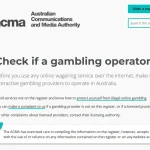
Enforcement sits with the Australian Communications and Media Authority, generally known as ACMA. The authority oversees compliance with federal rules governing interactive gambling and acts under the Interactive Gambling Act. Its reach includes asking Australian internet service providers to block websites where prohibited gambling services are supplied or advertised to people in Australia. A request to block access is an enforcement tool; it is not a licence assessment that turns an offshore site into a domestic operator.
The scale of that work is described through two different counts. ACMA reports having blocked more than 1,455 illegal gambling and affiliate websites after enforcement action began in November 2019. That figure concerns blocked websites, including affiliate sites, rather than a count of operators or players. A separate measure concerns illegal services that left the Australian market after ACMA began enforcing the rules in 2017. Here, published accounts disagree: one gives a total of more than 210 withdrawals, while another says more than 190. The figures should not be collapsed into one precise tally. They indicate enforcement activity, but the disagreement is part of the record.
ACMA Enforcement
The ACMA has blocked over 1,455 illegal gambling and affiliate websites since November 2019, and has overseen the withdrawal of between 190 and 210 illegal services from the market.
The presence of an offshore licence can be easy to misread. It belongs to the jurisdiction that issued it and does not establish that the business may legally provide online pokies to Australians. Nor does a familiar game title, a polished site or an accessible webpage alter the statutory position. The relevant question is not whether a service looks established, but whether the law permits it to offer the service in this country. For online casino games, the answer is that operators may not provide them to people physically located in Australia.
The division between operator responsibility and player liability is also worth keeping exact. Saying that players face no penalty under the Interactive Gambling Act is not the same as saying that online pokies are approved, regulated locally or protected by Australian licensing. The prohibition remains directed at supply. A player’s lack of liability does not confer legitimacy on the site.
The legislation also forms part of a broader national approach to interactive gambling, in which the regulator can act against services and advertising rather than relying only on a customer-facing warning. ACMA’s blocking requests are one visible expression of that approach. Sites may disappear from access after enforcement, while others may remain reachable for a time; accessibility alone is not evidence of lawful status. The distinction is plain, if not especially comforting: availability is not permission.
7-Reel Slots in Australia: How Each Spin Works
For anyone comparing high-volatility online slots or high-volatility pokies in Australia, the legal setting therefore comes before any description of a game. This is not a judgement on a particular title or a claim about its results. It is the boundary around the market: Australian law prohibits operators from supplying online pokies here, while the player is not penalised under the Act for playing. Offshore authorisation changes neither side of that distinction. ACMA monitors compliance and can seek to restrict access to prohibited services and their advertising. The structure is less a local casino regime than a prohibition enforced against providers. That is the backdrop.
A Spin Has No Memory
A run of empty spins can feel like a story gathering force. The screen has offered nothing, the balance has fallen, and the next press begins to look like a moment of correction. In a high-volatility pokie, that feeling can be especially persuasive: rare larger payouts are part of the profile, so a long wait may seem to point towards a reward. It does not.
Each spin is generated independently by a random number generator. The result of an earlier spin does not alter the next one, and the next combination cannot be read from a sequence of past outcomes. A run of losses is not a signal that a win is due. Nor does a recent payout make another one less likely on the next spin. The machine has no memory to consult.
That distinction can be difficult to hold onto because people are skilled at finding patterns, particularly when money and suspense are involved. A sequence of near misses, repeated symbols or quiet spins can acquire the shape of evidence. But appearance is not prediction. Past results describe what has already happened; they do not disclose what the RNG will produce next.
Do
- Understand that each spin is independent
- Set a budget before the session
- Keep stakes small and disciplined
Don’t
- Believe a win is “due” after losses
- Use systems to try and beat the RNG
- Increase stakes to force a result
This is also why high volatility does not make a pokie more predictable. Volatility describes a broad pattern of outcomes, not a timetable for them. A game associated with infrequent, larger payouts can still produce a long stretch without one, and nothing in that stretch establishes when the pattern will change. The label cannot tell whether the next spin will be favourable, or whether a session will contain a substantial payout at all.
There is no system that beats a pokie. Changing the order of spins, waiting after a loss, or increasing a stake because a feature seems overdue cannot manipulate an independently generated result. Such rituals may make play feel more orderly, but they do not give the player control over the random combination. The house edge remains built into the game; a strategy cannot remove it.
The same reasoning applies to claims that a certain time, betting rhythm or sequence of buttons can influence a result. Without control over the RNG, those actions do not reach into the outcome. They can change how much is wagered, and therefore how quickly a balance is exposed to risk, but they cannot make the next combination more favourable. A sense of influence is not influence.
This matters when deciding whether high volatility is “good”. It is not a quality that predicts a personal result. It describes a pattern some players may choose to accept: larger payouts are less frequent, and the wait can be extended. Whether that trade-off suits someone depends on their tolerance for uncertainty and the money set aside for play, not on a belief that a dry spell has nearly run its course.
Pokie Machines in Australia: Rules, Odds and Risks
A budget gives that uncertainty a boundary. Stakes should remain disciplined, and no more should be wagered than can be afforded to lose. High-volatility games may empty a small balance before a feature appears; a hoped-for future outcome cannot restore money already spent. The responsible limit is the one decided before the session, not one revised in response to a losing sequence.
Randomness does not promise balance within a short session. It does not owe a correction, and it does not recognise persistence. The next spin begins without knowledge of the last one. It is an unromantic mechanism.
RTP Is an Average, Not a Session Forecast
Return to player, or RTP, describes a game’s theoretical return across a very large number of plays. It is a long-run measure, not a promise about what comes back during one person’s session. A result can fall well below that average, or rise above it; the measure does not set a timetable for either outcome.
Volatility describes a different feature. It concerns the shape of the payout pattern: how often returns occur and how they are distributed. RTP concerns the overall theoretical return over time. The two measures can therefore tell different parts of the story, rather than competing to answer the same question. A high RTP does not, by itself, mean that wins will arrive steadily, and a high-volatility profile does not establish a game’s RTP.
Casino Games: Slots, Pokies and Table Games
That distinction matters when games are described as both high-RTP and high-volatility. The phrase may sound like a comfortable compromise, but it cannot turn a long-run figure into a session forecast. A favourable theoretical return, where one is stated, does not remove the uncertainty of individual results or make a particular stretch of play predictable. The label supplies no schedule.
Nor does RTP reveal how a bankroll will fare before the long-run measure becomes meaningful. A short session can end with a loss even where the published return appears attractive. High-volatility pokies may also exhaust a small balance before a feature arrives. The average is patient; a player’s balance is not necessarily so.
There is no system that beats a pokie. Each spin is independent, and the game has a built-in house edge; earlier results cannot be used to force later ones towards the RTP. Treating an average as a target for the next session only gives chance the appearance of an appointment.
A useful reading of RTP is modest: it can help describe a game’s theoretical return, but it cannot promise a personal outcome. It should be considered alongside volatility, not mistaken for a safety rating or a route to profit. A budget set in advance, with no wagering beyond what can be lost, is more practical than trying to make a long-run statistic govern a short-run session.
No forecast. Just a measure.
Frequent Small Wins or Rare Large Ones
Low-volatility pokies tend to return smaller wins more often. That rhythm can make a session feel less severe: the balance may be interrupted by modest returns rather than falling through long stretches without one. High-volatility games reverse the emphasis. Their wins are less frequent, but can be larger; the quiet between them may be costly.
Live Roulette in Australia: Rules and Dealer Claims
The difference is not simply a choice between a calm game and an exciting one. It is a choice about how a bankroll is exposed to uncertainty. Frequent small wins can soften the experience of losses, but they do not ensure that the balance holds steady. Rare larger payouts can change a session sharply, but there is no schedule for when they might appear. A sequence of small returns is not proof that a game is safer, and a long losing stretch does not make a larger win due.
So is high or low volatility better for pokies? Neither profile is better in the abstract. The fit depends on how much uncertainty a player can tolerate and how quickly a balance can be spent without affecting ordinary commitments. A person seeking frequent, modest returns may find low volatility less punishing in feel. Someone prepared for a longer wait and a deeper bankroll may accept the greater swings of high volatility. These are preferences about risk, not methods for improving the chance of profit.
High-volatility play calls for small, disciplined stakes. Larger wagers can drain a bankroll rapidly while the game is producing little in return; a small balance may be gone before a feature appears. Changing stakes in response to a winning or losing run does not make the next result more favourable. No system beats a pokie: each spin is independent, and the game has a built-in house edge.
Low Volatility
Returns smaller wins more often, which can make a session feel less severe.
High Volatility
Wins are less frequent but can be larger, often involving costly quiet stretches.
A budget matters more than a preferred label. Setting a fixed amount for gambling, and never wagering more than can be afforded to lose, puts a boundary around a pastime whose outcomes cannot be managed. Once that amount is gone, continuing does not restore it. The distinction between volatility profiles helps describe the shape of possible sessions, not control their ending.
The social appeal of frequent small wins is easy to understand: visible returns can make play feel less barren. The attraction of rare large ones is just as plain, though its price is less visible until the quiet stretches arrive. Neither rhythm changes the underlying bargain.
Progressive Jackpots and the Price of Waiting
A progressive jackpot is built from the wagers placed on the game: a portion of each stake feeds a prize that grows over time. That arrangement changes the shape of the game. Some of the money wagered is directed towards a large, accumulating award rather than returning as frequent smaller payouts, so progressive pokies generally pay out less often and tend to have high volatility.
The growing figure on screen can make the wait feel like part of the entertainment. It is also a reminder of how the prize is funded. The jackpot does not make each spin more likely to succeed as it rises, and earlier results do not improve the odds of the next one. Each spin is independent; no system can beat a pokie.
Lightning Link Online Pokies in Australia: What to Know
That distinction matters because a progressive prize is visible, while the time and losses involved in waiting for it are not. A small balance may be exhausted before a feature or jackpot arrives. High-volatility play calls for disciplined, smaller stakes, not a larger wager in pursuit of the growing total. Set a budget in advance and never wager more than can be afforded to lose.
Australia’s legal setting is separate from the game’s mechanics: the Interactive Gambling Act 2001 prohibits operators from providing online pokies to people in Australia, while players face no penalty. No online pokie site is licensed in Australia; sites serving the market operate offshore.
A rising jackpot is a compelling display. It is not a forecast.
Bonus Stages Can Stretch the Dry Spell
A bonus feature can look like a destination, but in games with several stages it may be only a passage to another uncertain outcome. Each added stage gives the game another place for a payout to fail to arrive in a useful form. Games built around multiple bonus stages pay out less frequently, a pattern associated with low RTP and high volatility.
Even a conspicuous payout is not the same as a profitable round. A bonus can produce a large return and still leave the overall result below the amount staked to reach it. The size of one prize can draw the eye away from the cost of the spins around it. The arithmetic is less theatrical.
That matters particularly when a small balance is being asked to wait for a feature. High-volatility pokies may run through that balance before a bonus appears; reaching a bonus does not mean its stages will repay the wait. Bonus-buy options, where offered, do not turn that uncertainty into a dependable route to long-term profit.
Reaching a bonus stage does not guarantee that the outcome will repay the cost of the spins required to trigger it.
Bonus weighting can vary between games, so chasing a feature without checking how the game is weighted is a poor substitute for understanding the risk. Sticky bonuses are also a bad fit for anyone whose priority is being able to cash out: their conditions can keep funds tied up. The sensible response is not to keep raising stakes in the hope of forcing a stage to appear. Rapid changes in bet size during bonus play may attract irregular-play scrutiny.
A fixed budget makes the boundary clearer. Stakes should remain small and disciplined, and never exceed money that can be lost without consequence. The bonus may be long, layered and visually generous; none of those qualities guarantees net profit. Sometimes the feature is simply another way to wait.
Pragmatic Slots and Irregular-Play Scrutiny
A provider’s name is not a volatility rating. Pragmatic Play makes games with their own rules and payout profiles, so the label “high volatility” should not be inferred from the logo or carried from one title to another. A search for high-volatility Pragmatic pokies may point towards a category, but the name alone says little about how a particular game behaves.
There is a separate question around how an offshore operator treats play it considers irregular. One affiliate review has warned that some operators based in Curaçao may scrutinise such activity closely. That is a report from a particular kind of source, not evidence of a consistent policy across Curaçao operators, and it does not establish any special connection to Pragmatic Play or its games. The subject can also change over time.
The phrase “irregular play” is not a useful prediction by itself. Without a stated operator rule, it does not explain what conduct might attract scrutiny or what response might follow. Claims that a particular Pragmatic title will trigger a review, or that a certain betting pattern will avoid one, would go beyond what this warning supports.
Best RTP Slots in Australia: How RTP Works
The distinction matters. Game volatility concerns the pattern of payouts; operator scrutiny concerns how an account is assessed. Treating the two as one issue can turn a general caution into a false promise of safety. No system beats a pokie: each spin is independent, with a built-in house edge.
High-volatility games can also drain a small balance before a feature appears. Any gambling budget should be set in advance, and wagering should never exceed what can be afforded to lose.
What a High-Volatility Label Can—and Cannot—Tell You
A high-volatility label describes a broad pattern: larger wins may occur, but they are rare. Lower-volatility games tend to return smaller wins more often. The distinction is useful when considering the shape of play, but it does not identify a reliable path to profit or say what any particular session will bring.
The label is not a ranking, a forecast or a promise. A game described as high volatility can still produce no meaningful return during a session; the possibility of a large win does not make that outcome more dependable. Nor does the label tell how long a player will wait for a feature or a payout. The uncertainty is the point, not a flaw that can be solved by choosing the right moment.
There is no system that beats a pokie. Each spin is independent, and the game retains a built-in house edge. A past run of losses does not make a win due, just as a recent payout does not signal that another is near. Treating the label as a clue about the next result gives it a power it does not have.
For Australian readers, the legal setting matters too: no online pokie site is licensed in Australia. Australian law prohibits operators from providing online pokies to people in the country, and services that reach Australians are offshore. That restriction does not make a volatility label safer or more informative.
High-volatility play can empty a small balance before a feature arrives. Any play should be bounded by a set budget, with no wagering beyond what can be afforded to lose. The label can describe risk; it cannot contain it.
Games

3-Reel Slots in Australia: Rules and Play
A three-reel layout offers a familiar compact display, while each game's paytable and instructions determine...

5-Reel Slots in Australia: Features and How They Work
A five-reel layout describes the columns, while features, paytable RTP and random outcomes shape how...
7-Reel Slots in Australia: How Each Spin Works
The reel count shapes the display, while RNG selects each result independently and RTP describes...

Bonus Buy Slots in Australia: Features and RTP
A practical guide to bonus-buy mechanics, demo limits and RTP, set against the restrictions shaping...

Low-Volatility Slots in Australia: What the Term Means
Low volatility points to a tendency toward frequent, smaller wins, not a fixed timetable or...

Pokie Machines in Australia: Rules, Odds and Risks
A practical look at machine mechanics, free-play limits and the legal and financial risks of...

Progressive Jackpot Slots: How Pools and Prizes Work
Progressive games vary in how wagers fund a pool, how prizes trigger and what rules...

Best RTP Slots in Australia: How RTP Works
RTP is a long-run statistical expectation; game versions, variance and Australia's legal context all shape...

Video Slots Australia: RNG, Free Play and RTP
A practical look at random outcomes, free-play observations and the information paytables and RTP can...

Casino Dice Games in Australia: Rules and Legality
This guide separates game mechanics, odds and live formats from the legal question of whether...

Crash Casino Games in Australia: Risks and Rules
Crash games turn a rising multiplier and a timed cash-out into a wager, but neither...

Lightning Link Online Pokies in Australia: What to Know
The original game is played on venue machines; online pages using its name do not...

Live Baccarat Online in Australia: Legal Context
Australia has no locally licensed online casino market; this guide explains the legal distinction and...

Live Blackjack Online in Australia: Legal Guide
Australia has no locally licensed online casino route; the article separates legal boundaries from claims...

Live Roulette in Australia: Rules and Dealer Claims
It distinguishes Australia’s regulatory position from claims about dealers, bonuses, odds and roulette strategies. Online...

Mines Casino Game in Australia: How It Works
The guide places Mines mechanics alongside free-play limits, bonus conditions, offshore access and questions about...

Plinko Casino in Australia: Legal Risks and Formats
The guide separates game formats from offshore real-money services and examines claims, payment terms and...

Pokies Tips and Tricks: What Actually Matters
A practical look at independent spins, bonus conditions and session budgets, without claiming any tactic...

Real Money Casino Table Games in Australia: Rules
The guide covers Australia's online gambling restrictions alongside table formats, player decisions, odds and the...