Pokie Machines in Australia: Rules, Odds and Risks
 Available in AU
A practical look at machine mechanics, free-play limits and the legal and financial risks of offshore online pokies in Australia.
Table of Contents
- Online Pokies in Australia: A Market Outside the Legal Framework
- The Machine Is a Set of Rules, Not a Promise
- Free Play, With One Important Asterisk
- What a Casino Floor Can Actually Tell About a Pokie
- Why Some Pokies Link Their Jackpots
- Odds, Volatility and the Myth of a Due Spin
- Real-Money Play and the Limits of Offshore Recourse
- Pokies on a Phone: Payments Are Not the Same as Regulation
- New Names, Familiar Mechanics
- RTP Is a Long View, Not a Session Forecast
- Games
Online Pokies in Australia: A Market Outside the Legal Framework
The legal line around a pokie machine is not drawn only by the game itself. It also depends on where the machine is offered and who is offering it. Australia has a land-based gambling sector, but there is no Australian licence under which an operator can offer real-money online pokies to residents. A screen may reproduce the familiar shape of a machine; that resemblance does not bring the service within a lawful local licensing system.
The Interactive Gambling Act 2001 places the prohibition on the provider. Offering online pokie machine games for real money to people in Australia is an offence for an operator. The same framework treats online casino-style games as prohibited interactive gambling services when they are supplied to customers here. An offshore address or a licence issued elsewhere does not create an Australian authorisation. In this market, the legal framework does not provide a local route for licensing online casino play.
That distinction matters because the law does not make the individual player’s act an offence under the Act. An Australian resident who chooses to play for money with an offshore operator is not committing an offence on that account. The statutory focus is on the service being supplied, not on prosecuting the person at the other end of the connection. This is a narrow but important distinction: it does not turn the operator’s service into a lawful Australian product.
Choosing a pokie machine is only part of the decision: payment terms and licensing can also help you assess where to play. Use these operator notes as a starting point and check the current terms before signing up.
1. MrPacho
Payout speed: crypto 30-120 minutes, fiat 24-72 hours · Min. deposit: A$30
MrPacho lists crypto payouts at 30–120 minutes and fiat payouts at 24–72 hours. Its minimum deposit is A$30.
2. Rollero Casino
License: Curacao Gaming Control Board OGL/2023/176/0095 (Hollycorn N.V.)
Rollero Casino lists a Curaçao Gaming Control Board licence, OGL/2023/176/0095, held by Hollycorn N.V.
3. Neospin
License: Curacao Gaming Control Board OGL/2023/176/0095 (Hollycorn N.V.)
Neospin lists a Curaçao Gaming Control Board licence, OGL/2023/176/0095, held by Hollycorn N.V.
4. LevelUp Casino
License: Curacao eGaming OGL/2023/174/0082 (Dama N.V.) · Min. deposit: A$15
LevelUp Casino lists a Curaçao eGaming licence, OGL/2023/174/0082, held by Dama N.V. Its minimum deposit is A$15.
5. SkyCrown
License: Tobique Gaming Commission · Payout speed: crypto ~10-15 minutes, fiat 1-5 days · Min. deposit: A$30
SkyCrown lists a Tobique Gaming Commission licence, with crypto payouts at about 10–15 minutes and fiat payouts at 1–5 days. Its minimum deposit is A$30.
6. SpinsUp
License: Curacao Gaming Control Board OGL/2023/174/0082 (Dama N.V.)
SpinsUp lists a Curaçao Gaming Control Board licence, OGL/2023/174/0082, held by Dama N.V.
7. Vegaz Casino
License: Curacao OGL/2024/1335/0780 · Min. deposit: EUR 20
Vegaz Casino lists a Curaçao licence, OGL/2024/1335/0780. Its minimum deposit is EUR 20.
8. Kingmaker
Payout speed: crypto ~90 minutes, fiat 1-5 days · Min. deposit: A$30
Kingmaker lists crypto payouts at about 90 minutes and fiat payouts at 1–5 days. Its minimum deposit is A$30.
9. WinSpirit Casino
License: Curacao eGaming OGL/2024/923/0383 (Antillephone N.V.) · Min. deposit: A$30
WinSpirit Casino lists a Curaçao eGaming licence, OGL/2024/923/0383, held by Antillephone N.V. Its minimum deposit is A$30.
10. Uptown Pokies
License: Curacao (operating since 2017) · Min. deposit: A$20
Uptown Pokies lists a Curaçao licence and has operated since 2017. Its minimum deposit is A$20.
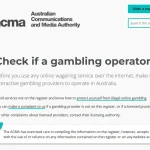
Nor does it mean that an offshore website is beyond the reach of Australian authorities. The Australian Communications and Media Authority, or ACMA, is the federal agency responsible for enforcing the Interactive Gambling Act and monitoring compliance with federal interactive gambling rules. Its work includes action against prohibited services and advertising, rather than the creation of a local licence for them. The absence of a player offence and the presence of enforcement are not contradictory. They apply to different parts of the arrangement.
ACMA can ask Australian internet service providers to block access to websites that supply prohibited interactive gambling services or advertise them in Australia. Blocking is a practical form of enforcement: the service may remain hosted elsewhere, but its availability through Australian internet connections can be restricted. It is not a declaration that every inaccessible site has disappeared, or that every offshore service has been removed from view. It is one means of limiting access to services that should not be offered here.
The scale of that work is substantial. Since November 2019, following enforcement action, ACMA has blocked more than 1,455 gambling and affiliate websites considered illegal. The count includes affiliate sites as well as gambling services, a reminder that the commercial machinery around online pokies is broader than the game itself. Advertising and referral pages can help direct people to a service even when the operator is based offshore.
Video Slots Australia: RNG, Free Play and RTP
There is also a discrepancy in the published withdrawal totals. One figure says more than 210 illegal services have left the Australian market since ACMA began enforcing the rules in 2017; another reports over 190 departures over the same period. Those figures should not be collapsed into a single precise count. Both describe services withdrawing after enforcement began, but the totals conflict.
The legal position is therefore neither that online pokie machine games are licensed here nor that every person who encounters them is breaking the law. The operator is prohibited from supplying real-money play to people in Australia; the resident player is not made an offender by playing under the Act. ACMA’s blocking powers and enforcement actions address the supply side, while the lack of an Australian licence remains the defining feature of the market.
This is different from walking into a land-based venue where machines are offered under the rules applying to that setting. Online access does not inherit that status simply because the software imitates a physical machine. A free online pokie machine or simulator is also a different matter from a real-money service, but the legal question here is the offer of gambling for money, not how a game looks or behaves. The distinction is less about pixels than jurisdiction.
Legal Risk
Offering online pokie machine games for real money to people in Australia is an offence for the operator under the Interactive Gambling Act 2001.
A machine on a screen can appear self-contained: symbols, buttons, a balance and a result. Legally, it sits inside a chain of conduct involving an operator, a customer in Australia and a service delivered across borders. The law places its prohibition on the operator, while ACMA’s enforcement tools reach toward the access routes and advertising around that service. The player’s position is different, but that does not supply the offshore operator with a local licence.
A market can be visible without being authorised. That is the awkward arrangement.
The Machine Is a Set of Rules, Not a Promise
A pokie can look inviting before its rules are clear. Bright symbols and a familiar cabinet say little about how a particular game is arranged. The useful information is less theatrical: the paytable, the paylines and the rules displayed on the machine. These are the parts that distinguish one title from another before anyone presses a button.
The paytable sets out what combinations of symbols are worth within that game. It gives the machine’s own terms for matching symbols and shows how prizes relate to those combinations. Comparing paytables is not simply a matter of finding the largest figure on the screen. The figures belong to a structure: which symbols count, how they must appear and what line or pattern connects them. Without that structure, a prize table is a list without a grammar.
Paylines provide some of that grammar. A line marks a route across the reels on which a qualifying combination may be recognised. Titles can offer different numbers of paylines, and those lines may be fixed or variable. A fixed-line game keeps its line arrangement set; a variable-line game allows the number of active lines to be adjusted. That difference changes how the machine’s rules are applied, so the displayed information matters more than a general impression of how busy or generous the screen appears.
Live Blackjack Online in Australia: Legal Guide
The rules explain how the paytable and paylines fit together. They may identify the symbols used in a game and describe conditions attached to particular prizes or features. A machine’s presentation can make the play look self-explanatory; its written rules are the more dependable account of what the game recognises. A title that resembles another may still have a different paytable or a different line arrangement. Familiar artwork is not a substitute for reading the terms.
This is why the phrase “best pokie machine” has no useful meaning without a criterion. A player comparing machines could be looking for a particular theme, a certain layout, or rules that are easier to follow. Those are different preferences, not a universal ranking. Even two machines with a similar appearance can ask for different choices because their paylines and paytables are not the same. The label “pokies machine” sometimes appears in casual speech, but the object remains a game with its own published rules—not a promise that one title will suit every player.
Local requirements make the display more than a courtesy. In Victoria, the Victorian Gambling and Casino Control Commission requires electronic gaming machines to show their RTP, and a person must be at least 18 to play an electronic gaming machine there. The disclosure requirement is part of the information presented on the machine; it does not turn the display into a forecast of what a particular session will produce.
Local Disclosure
In Victoria, the Victorian Gambling and Casino Control Commission requires electronic gaming machines to show their RTP, and players must be at least 18 years old.
Western Australia takes a direct approach to the rules themselves: every legal pokie there must show its rules, paylines and prize table. The point is practical. These details allow the game’s structure to be seen at the machine, rather than inferred from its graphics or from the name printed above the screen. A displayed rule can be checked; a general impression cannot.
A pokie machine is therefore best understood as a set of terms arranged behind a moving display. Paytables identify prize combinations, paylines define routes for recognising them, and the rules connect the two. The cabinet may be designed to attract attention. The rules do the less glamorous work.
Free Play, With One Important Asterisk
A free-play version of a pokie can be useful for learning its interface. It shows how the reels move, where the controls sit and how a game presents its features, without requiring a real-money stake. For someone curious about a particular theme or unfamiliar layout, that small rehearsal can make the software easier to understand.
The qualification matters more than the rehearsal. Demo results do not predict real-money outcomes. A run of wins in free play is not evidence that the same pattern will appear when money is involved, and a string of losses does not mean that a later session will compensate. Online pokie outcomes are generated by a random number generator; each spin is independent of the one before it. Practice can teach where to tap or how a screen is organised. It cannot teach a machine to pay.
That is the boundary between learning an interface and learning an outcome. Free play may make a game feel familiar, but familiarity is not an advantage over the random process. A theme can be memorable, the animation persuasive, the sound satisfyingly decisive. None of these is a forecast. The machine is better at theatre than prophecy.
Mines Casino Game in Australia: How It Works
A free pokie may also omit or simplify parts of the real-money experience. The available version depends on the game and the site presenting it; the demo should be treated as a way to inspect the interface, not as a complete rehearsal of every condition attached to paid play. In particular, free-play credits are not a bonus balance. They are practice counters, and they cannot be cashed out.
Bonuses belong to a different arrangement. They may look like money added to an account, but the conditions attached can make them harder to use than their headline suggests. Wagering requirements specify how much must be staked before bonus-related funds can be withdrawn. A specialist review gives a clear illustration: a $100 bonus with a 30x wagering requirement calls for $3,000 in bets before cashout. That is not a forecast of what any particular offer requires; it shows how a multiplier can turn a modest-looking sum into substantial betting.
The distinction between bonus funds and withdrawable winnings deserves close attention. Bonus funds may remain subject to wagering requirements and cashout limits, so the displayed balance does not necessarily represent money ready to leave an account. Terms can determine which games count toward the requirement and how bonus funds are treated. Those details matter more than the bright number on a welcome screen.
Demo play and bonuses are often placed near each other in a site’s navigation, but their purposes differ. One lets a person explore a game without staking money. The other is an offer with conditions, and may require real-money betting before withdrawal is possible. Calling both “free” blurs a useful distinction: one is practice; the other may come with an obligation to wager.
Do
- Use free play to learn the interface
- Inspect the screen and controls
- Identify if the presentation is appealing
Don’t
- Use demo results to predict outcomes
- Try to validate a strategy via free play
- Treat practice credits as a bonus balance
A sensible use of free play is therefore modest. It can answer practical questions about the screen and controls, and help identify whether a game’s presentation is appealing. It cannot validate a strategy, establish a winning rhythm or reproduce the financial conditions of paid play. The apparent lesson of a lucky demo session is particularly easy to misread because nothing is at stake. That is precisely why it teaches so little about what happens when there is.
What a Casino Floor Can Actually Tell About a Pokie
Crown Perth offers a useful view of what a physical casino can make visible—and what it leaves obscure. It is Perth’s only legal land-based casino, with a floor holding more than 2,500 gaming machines. That scale gives a visitor plenty of choice, but size alone says nothing about which machine will pay more in any particular session.
The minimum bet varies by machine. At Crown Perth, it typically falls between $0.20 and $2.00 per spin. That range is a practical detail, not a ranking: a lower starting stake does not establish that a pokie is more generous, and a higher one does not imply a better chance of a payout. The floor offers different entry points, but not a dependable shortcut to choosing a “best” machine.
3-Reel Slots in Australia: Rules and Play
RTP offers another point of comparison. Most machines at Crown Perth operate within a range of 87% to 92%. The figure describes a game’s return over a very large volume of play, rather than a promise about an individual visit. A machine at the upper end of that range cannot be assumed to deliver more during a short session than one at the lower end. In the language of a casino floor, the percentage is a property of the game, not a forecast for the person sitting in front of it.
There is also a limit to how specifically those figures can be used. Crown Perth does not publish an RTP list for each individual machine. Knowing the broad range therefore does not reveal the exact setting attached to every cabinet, nor does it support a reliable list of the highest-paying machines on the floor. The public picture is wide-angle, not a machine-by-machine map.
That gap matters because a large floor can look like a catalogue of comparable choices. Rows of familiar cabinets invite comparison, while the information available may not identify the precise RTP of each one. A visible game title, a modest minimum bet or a busy bank of machines cannot fill in that missing detail. Nor does a casino’s overall range mean every machine is set to the same figure.
The distinction between the physical floor and online play is especially clear in Western Australia. Crown Perth is the legal land-based casino in Perth; there is no legal online casino market in the state. A machine encountered there belongs to a regulated physical venue, not to an online equivalent that can be assumed to offer the same terms or protections. The familiar appearance of a pokie on a screen does not make the setting equivalent.
Casino Floor Facts
- Minimum bets at Crown Perth typically range from $0.20 to $2.00.
- Most machines operate within an RTP range of 87% to 92%.
- Precise RTPs for individual machines are not publicly listed.
- Crown Perth is the only legal land-based casino in Perth.
So a casino floor can tell something concrete: the venue’s scale, the range of minimum bets, and the broad RTP band in which most of its machines operate. It cannot, from Crown Perth’s published information, identify an exact RTP for each machine or name a guaranteed winner. The floor is legible up to a point. Then the detail stops.
Why Some Pokies Link Their Jackpots
A pokie can look like a solitary contraption: one screen, one set of buttons, one person watching the symbols settle. Networked jackpot games complicate that picture. Titles such as Lightning Link, Dragon Link and Cash Express can connect machines across a number of cabinets or casinos, allowing a progressive jackpot to build across that wider network.
The distinction is between the machine in front of a player and the system behind the prize. A cabinet is the visible point of play; the jackpot may belong to a shared structure extending beyond it. The screen gives the game a local presence, but the prize pool is not necessarily confined to that one machine. Several locations can, in effect, sit under the same jackpot umbrella.
That arrangement changes the scale of the spectacle. A prize attached to a single machine has a natural boundary: that machine. A networked progressive jackpot can draw on a much larger field of linked machines. The result is a jackpot capable of growing to a substantial size, though the network itself does not promise that any particular spin will win it.
There is a social history in that design. Casinos have long had reason to make a prize feel larger than the room containing it. Linking games gives the jackpot a kind of distant life: each machine appears to offer the same shared possibility, while the pool spans places most players will never see. The network turns separate cabinets into participants in one prize structure. A tidy piece of theatre.
5-Reel Slots in Australia: Features and How They Work
This is not the same thing as simply placing identical games side by side. A bank of machines may share a look or title without sharing a jackpot. The defining feature here is the connection that lets the progressive prize build across multiple machines or casinos. The cabinet is still where the game is played; the network is what broadens the pool.
For anyone trying to understand real pokie machine games, the useful distinction is therefore not merely which title is on the screen. It is whether the game’s jackpot is local to a machine or linked across a wider system. The names Lightning Link, Dragon Link and Cash Express are familiar examples of networked games, but the important point is their shared structure, not any promise attached to a title.
A progressive jackpot can make a game’s prize feel as though it belongs to a crowd rather than a room. Yet scale is not certainty. The network explains how a prize can grow across locations; it says nothing about when it will be won, or who will be there when it is.
Odds, Volatility and the Myth of a Due Spin
Volatility describes the shape of a pokie’s payouts, not a promise about what the next spin will do. A low-volatility game tends to pay smaller amounts more often. A high-volatility game pays less often, but its wins can be larger. The distinction is about the pattern of returns, not a schedule a player can read from the screen.
Understanding Volatility
Low-volatility games tend to provide smaller payouts more frequently, while high-volatility games offer less frequent but potentially larger wins. Neither describes a schedule for the next spin, as outcomes are random.
That difference matters when people talk about the “best” pokie to play or the best pokie to win on. A game with frequent small payouts may feel more active; a game with rarer, larger payouts may feel quieter until something happens. Neither description identifies which machine will pay on a particular spin. Volatility alone cannot say whether the next spin will win, how much it might return, or when a larger prize might appear.
Nor does a winning sound settle the question. Lights and sounds can make a result feel momentous, but they are presentation, not evidence that a machine is becoming more generous. The arithmetic is less theatrical.
Each spin is independent of the one before it. Its outcome is generated by a random number generator, and previous results have no influence on what comes next. A run of losses therefore does not make a win due. The machine has no memory of the sequence in the human sense; it does not recognise that patience has been tested, or that a player has “earned” a return.
This is where ordinary intuition gets in trouble. People are good at finding patterns, especially in repetition. After several losses, the next spin can seem overdue; after a win, it can seem as though momentum has arrived. Both interpretations turn a sequence into a story. The game’s independence offers no such plot.
For anyone asking how to play a pokie machine, the useful distinction is modest: volatility helps describe the kind of payout experience a game is designed to produce, but it does not forecast an individual result. A preference for smaller, more frequent wins may point towards lower volatility; comfort with less frequent payouts and the possibility of larger ones may point towards higher volatility. Those are preferences about texture, not methods for improving the chance of a particular spin.
There is no single best pokie machine to play in Australia in 2026 on the basis of volatility alone. A label cannot turn uncertainty into a strategy, and a losing streak cannot alter the next outcome. That is not a flaw in the player’s reading of the machine. It is the rule the machine is built to follow.
No spin keeps score.
Real-Money Play and the Limits of Offshore Recourse
A pokie can look much the same whether its credits are only part of a demonstration or represent money that can be won and withdrawn. The distinction is not in the symbols on the screen. It is in what the credits mean: demo play is practice with no real-money stake, while real-money play involves funds that may be lost or winnings that may be claimed.
That difference matters legally. The Interactive Gambling Act 2001 makes it an offence for an operator to provide real-money online pokie games to people in Australia. An Australian resident who plays with an offshore operator is not, by that fact alone, committing an offence under the Act. The law places the prohibition on the provider, not the individual player.
That is not the same as saying the arrangement is locally regulated or protected. Australia has no licence for offering real-money online pokies to Australian residents. An offshore licence does not become an Australian authorisation because a site accepts Australian customers, displays familiar payment options or presents itself as established. Those details may make a service look orderly; they do not create local oversight.
Recourse Limitation
Players using offshore operators may have no effective local legal route to compel payment if a casino refuses to release winnings.
The practical weakness appears when a dispute arises. If an offshore casino refuses to release winnings, the player may have no effective local legal route to compel payment. A licence issued elsewhere may give the operator a framework in its own jurisdiction, but it does not guarantee that an Australian customer can obtain a remedy at home. The gap between a claim on a screen and money received can therefore be more than administrative.
Demo results offer no assurance about real-money outcomes. A run of wins in a practice version does not predict what will happen when money is staked; nor does familiarity with an interface change the legal status of the service. Practice is practice. Money changes the stakes, not the law’s allocation of responsibility.
This is the awkward division at the centre of offshore play: the individual player is not criminalised under the Interactive Gambling Act for participating, yet the service itself is prohibited from offering real-money online casino games in Australia. That distinction can be easy to miss when a site behaves like an ordinary entertainment product. The customer-facing design is smooth; the legal remedy, if something goes wrong, may not be.
A screen can accept a bet without offering the protections associated with a locally regulated service. And a balance displayed in an account is not the same thing as money in hand.
Pokies on a Phone: Payments Are Not the Same as Regulation
A phone can make an offshore gambling site resemble an ordinary app: familiar buttons, saved details and a screen designed for a small display. The resemblance is cosmetic. A smooth interface, or the technical connection that lets it load games, says nothing about whether the service is lawful in Australia. Real-money online pokies are prohibited for operators to provide to people in Australia; an app-shaped doorway does not alter that.
Payment menus can create a second impression of legitimacy. A specialist review reports that offshore sites may list Visa and Mastercard, bank transfers, and cryptocurrencies such as Bitcoin and Ethereum as deposit methods. That is a description of what a site may offer, not approval of the transaction or evidence of Australian regulation. Credit card payments must not be accepted for online gambling services. The payment logo is not a licence.
The distinction matters because a deposit is only one side of the arrangement. A withdrawal can remain pending for 24–72 hours, and some casinos may use that interval to prompt a customer to reverse it and continue gambling. The screen may frame reversal as a convenient option; in practice, it returns money intended for withdrawal to the balance available for play. A button can make that decision look routine. It is still consequential.
Nor does a mobile app create local oversight where none exists. Victoria has no state-issued licence for online casinos, and players have no local regulatory recourse through a Victorian online-casino licensing system. An offshore operator’s own payment process remains its process, not a substitute for Australian supervision.
The practical appeal is clear enough: a phone keeps a game within reach, while payment interfaces compress deposit and play into a few taps. That convenience can blur distinctions that ought to stay visible—between an app-like presentation and a lawful service, between a listed payment option and a permitted one, and between a pending withdrawal and money already returned to a bank account.
Payment Caution
Listed payment methods like Visa, Mastercard, or cryptocurrencies on offshore sites are not evidence of Australian regulation, and credit card payments must not be accepted for online gambling services.
A phone is an efficient container. It is not a regulator.
New Names, Familiar Mechanics
A fresh title does not necessarily bring a fresh kind of game. Pokie catalogues put recent releases beside familiar names such as Chilli, Buffalo, Book of Dead and Immortal Romance. The artwork and setting may change; the broader attraction of a recognisable format can remain. A name can signal a mood or a theme, but it cannot tell much about how a particular version plays.
That is why “new” is a slippery label. It may describe a recent release, a title newly added to a particular catalogue, or simply a game unfamiliar to the person encountering it. None of those meanings establishes that it is better than an older pokie. Nor does a new title name amount to a useful ranking: names alone say little about a game’s formal rules.
Some releases add a feature-buy option. Instead of waiting for the bonus feature to arrive during ordinary play, a player can pay a premium to trigger it immediately. Specialist reviews describe such prices as often ranging from 50 to 100 times the base bet, though that is not a universal setting and can vary by game. The bought feature is commonly free spins, but paying to enter a bonus does not promise a win.
This option changes the rhythm of play as much as the price. The bonus is no longer an interruption that might appear; it becomes the thing purchased. That can make the feature feel more central than the underlying game, while making the cost of reaching it plain. A purchase, not a shortcut to profit.
The best way to read a catalogue of pokie machine names is therefore as a record of continuity and variation, not a parade of guaranteed improvements. Chilli and Buffalo can sit alongside Book of Dead and Immortal Romance without forming a meaningful order from newest to best. A title may be new to a screen and still belong to a well-established kind of game.
For anyone comparing releases, the useful distinction is between the name and the rules attached to that version. Familiar branding may make a game easy to recognise; only its displayed terms explain what that particular machine offers.
RTP Is a Long View, Not a Session Forecast
RTP, or return to player, is a measure of what a game returns across a very large number of spins, not a forecast for one person’s session. A published figure therefore says little about what happens over a short run: a pokie can return less than its stated RTP for a stretch, or more, without the long-run measure being contradicted.
Best RTP Slots in Australia: How RTP Works
The figure can also depend on the version in use. Some providers let operators select from several RTP settings for the same game, so a number shown in a review or elsewhere may not describe the version presented by a particular casino. The specific game information matters more than a headline figure.
A specialist review, for instance, lists Gates of Olympus at 96.5% RTP and Sweet Bonanza at 96.48%. Those are figures reported for the versions covered by that review, not a guarantee that every casino offers those settings. A higher RTP does not ensure short-term wins; the difference is statistical, accumulated over an enormous volume of play.
That distinction gives RTP its proper, rather unglamorous role. It can help compare published game settings, but it cannot turn a session into a predictable calculation. Nor does a figure near the top of a comparison make a loss harmless: the money at stake is immediate, while the measure operates over a scale no individual session can supply.
Practical pokie machine tips begin with that mismatch. Check the RTP shown for the specific version, and set a loss limit before play begins. Once that limit is reached, the long view offers no reason to keep going.
Games

3-Reel Slots in Australia: Rules and Play
A three-reel layout offers a familiar compact display, while each game's paytable and instructions determine...

5-Reel Slots in Australia: Features and How They Work
A five-reel layout describes the columns, while features, paytable RTP and random outcomes shape how...
7-Reel Slots in Australia: How Each Spin Works
The reel count shapes the display, while RNG selects each result independently and RTP describes...

Bonus Buy Slots in Australia: Features and RTP
A practical guide to bonus-buy mechanics, demo limits and RTP, set against the restrictions shaping...

High-volatility slots in Australia: what to expect
High volatility means larger payouts are infrequent and quiet stretches can last, rather than signalling...

Low-Volatility Slots in Australia: What the Term Means
Low volatility points to a tendency toward frequent, smaller wins, not a fixed timetable or...

Progressive Jackpot Slots: How Pools and Prizes Work
Progressive games vary in how wagers fund a pool, how prizes trigger and what rules...

Best RTP Slots in Australia: How RTP Works
RTP is a long-run statistical expectation; game versions, variance and Australia's legal context all shape...

Video Slots Australia: RNG, Free Play and RTP
A practical look at random outcomes, free-play observations and the information paytables and RTP can...

Casino Dice Games in Australia: Rules and Legality
This guide separates game mechanics, odds and live formats from the legal question of whether...

Crash Casino Games in Australia: Risks and Rules
Crash games turn a rising multiplier and a timed cash-out into a wager, but neither...
Lightning Link Online Pokies in Australia: What to Know
The original game is played on venue machines; online pages using its name do not...

Live Baccarat Online in Australia: Legal Context
Australia has no locally licensed online casino market; this guide explains the legal distinction and...

Live Blackjack Online in Australia: Legal Guide
Australia has no locally licensed online casino route; the article separates legal boundaries from claims...

Live Roulette in Australia: Rules and Dealer Claims
It distinguishes Australia’s regulatory position from claims about dealers, bonuses, odds and roulette strategies. Online...

Mines Casino Game in Australia: How It Works
The guide places Mines mechanics alongside free-play limits, bonus conditions, offshore access and questions about...

Plinko Casino in Australia: Legal Risks and Formats
The guide separates game formats from offshore real-money services and examines claims, payment terms and...

Pokies Tips and Tricks: What Actually Matters
A practical look at independent spins, bonus conditions and session budgets, without claiming any tactic...

Real Money Casino Table Games in Australia: Rules
The guide covers Australia's online gambling restrictions alongside table formats, player decisions, odds and the...