Crash Casino Games in Australia: Risks and Rules
 Available in AU

Crash games turn a rising multiplier and a timed cash-out into a wager, but neither speed nor a streak makes the outcome predictable.
Table of Contents
- Crash Games, and the Australian Line Around Them
- What “Best” Means When the Evidence Is Thin
- Online Access Meets a Federal Blocklist
- The Slot Language Around Crash
- Crypto Payments: Speed Has a Price
- Bitcoin Searches, Same Withdrawal Caveats
- Free Play Is Not a Shortcut to Certainty
- “Cash or Crash” and the Cost of Pokies
- Strategy Cannot Turn Risk into Income
- Playing and the Promise of “Provably Fair”
- Games
Crash Games, and the Australian Line Around Them
A crash game turns a rising multiplier into the whole event. A figure climbs on screen; a round ends when it “crashes”. In versions involving money, a player’s potential return is tied to when a cash-out is made: leave before the crash and the multiplier may determine a payout, stay past it and the stake can be lost. The suspense is not a complicated set of rules but a narrow interval in which a rising number appears to offer one more moment.
That simple structure gives the format its name and separates it from familiar casino tables. There is no hand to read or wheel to follow. The central uncertainty is how far the multiplier will rise before the round stops. A crash casino game may be presented as a quick digital contest, but speed does not make its outcome predictable. Each round still involves risk, and a streak of rising figures offers no reliable promise about what the next one will do.
Casino Dice Games in Australia: Rules and Legality
The clean interface can make the wager seem incidental. It is not. When real money is involved, the game belongs to the wider category of online casino-style gambling, whatever its visual design or branding. Calling it a crash game rather than a casino game does not change the legal question of what service is being offered, or to whom.
In Australia, the governing boundary is unusually clear at the level of the operator. The Interactive Gambling Act 2001 makes it illegal for operators to provide real-money online casino games to people physically in Australia. The prohibited category includes online casino-style services such as slots, blackjack, roulette and poker. A crash format does not sit outside that framework simply because it uses a rising curve instead of cards or reels.
The law’s attention falls on supply, not on criminalising the individual who uses an offshore site. Australians are not made criminals merely for playing on such a service. That distinction matters, but it is not an endorsement or an assurance that the service is lawful, dependable or protected by Australian consumer rules. Offshore online casinos may accept Australian payments while operating under licences issued elsewhere. A payment method that works is not a local licence in disguise.
This is where the geography of online gambling becomes less abstract. A website can be designed abroad, take deposits from Australia and still offer a service that the Australian law prohibits operators from supplying to people here. The screen makes the distance disappear; the legal boundary does not. Nor does the presence of a foreign licence convert an offshore casino into a locally authorised online casino. Australia does not provide a general legal route for real-money online casinos to serve people in the country.
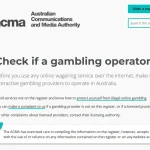
Enforcement is part of that boundary. The Australian Communications and Media Authority, or ACMA, is the federal body responsible for enforcing the Interactive Gambling Act and monitoring compliance with federal interactive gambling laws. It can ask Australian internet service providers to block websites that provide prohibited interactive gambling services or advertise them in Australia. The regulator has blocked more than 1,455 illegal gambling and affiliate websites since enforcement actions began in November 2019.
Legal Prohibition
The Interactive Gambling Act 2001 makes it illegal for operators to provide real-money online casino games to people physically in Australia.
The withdrawal figures attached to enforcement are also reported differently. One account says more than 210 illegal services have left the Australian market since ACMA began enforcing the rules in 2017; another gives the figure as over 190. Both describe services withdrawing, not a count of individual players, and neither turns the law into a guarantee that every offshore site will remain accessible or disappear at once. Enforcement is a process, not a single switch.
That distinction helps explain why a crash casino can appear in an Australian-facing conversation without becoming a lawful local product. The interface may be familiar, the language may be local, and payments may be accepted, while the service itself remains offshore and subject to blocking. Visibility is not authorisation. A search result is not a regulator.
The format’s appeal rests on a small, legible drama: rise, hesitate, exit—or miss the moment. Australia’s legal framework supplies a less theatrical line. It restricts the provision of real-money online casino services to people in the country, while ACMA can act against prohibited sites and their advertising. The two things should not be confused. A game may be easy to describe; its legal setting is not a feature of the game at all.
What “Best” Means When the Evidence Is Thin
Crash games move quickly, so it helps to check the operator details that matter before choosing where to play. This list offers a concise reference for Australian readers exploring crash casino games in 2026.
1. MrPacho
Payout speed: crypto 30-120 minutes, fiat 24-72 hours · Min. deposit: A$30
MrPacho lists crypto payouts in 30–120 minutes and fiat payouts in 24–72 hours. The minimum deposit is A$30.
2. Rollero Casino
License: Curacao Gaming Control Board OGL/2023/176/0095 (Hollycorn N.V.)
Rollero Casino lists a Curaçao Gaming Control Board licence, OGL/2023/176/0095, held by Hollycorn N.V.
3. Neospin
License: Curacao Gaming Control Board OGL/2023/176/0095 (Hollycorn N.V.)
Neospin lists a Curaçao Gaming Control Board licence, OGL/2023/176/0095, held by Hollycorn N.V.
4. LevelUp Casino
License: Curacao eGaming OGL/2023/174/0082 (Dama N.V.) · Min. deposit: A$15
LevelUp Casino lists a Curaçao eGaming licence, OGL/2023/174/0082, held by Dama N.V. Its minimum deposit is A$15.
5. SkyCrown
License: Tobique Gaming Commission · Payout speed: crypto ~10-15 minutes, fiat 1-5 days · Min. deposit: A$30
SkyCrown lists a Tobique Gaming Commission licence. Its stated payout times are about 10–15 minutes for crypto and 1–5 days for fiat; the minimum deposit is A$30.
6. SpinsUp
License: Curacao Gaming Control Board OGL/2023/174/0082 (Dama N.V.)
SpinsUp lists a Curaçao Gaming Control Board licence, OGL/2023/174/0082, held by Dama N.V.
7. Vegaz Casino
License: Curacao OGL/2024/1335/0780 · Min. deposit: EUR 20
Vegaz Casino lists a Curaçao licence, OGL/2024/1335/0780. Its minimum deposit is EUR 20.
8. Kingmaker
Payout speed: crypto ~90 minutes, fiat 1-5 days · Min. deposit: A$30
Kingmaker lists crypto payouts at about 90 minutes and fiat payouts in 1–5 days. The minimum deposit is A$30.
9. WinSpirit Casino
License: Curacao eGaming OGL/2024/923/0383 (Antillephone N.V.) · Min. deposit: A$30
WinSpirit Casino lists a Curaçao eGaming licence, OGL/2024/923/0383, held by Antillephone N.V. Its minimum deposit is A$30.
10. Uptown Pokies
License: Curacao (operating since 2017) · Min. deposit: A$20
Uptown Pokies is listed as operating since 2017 under a Curaçao licence. Its minimum deposit is A$20.
A label such as “best” can sound like a finding. In discussions of crash games, it is more often a bundle of assumptions: that a game is available, that its rules are clear, that its outcome claims can be checked, and that the surrounding terms are worth accepting. Those are separate questions. A polished page or confident ranking does not answer them merely by placing one name above another.
A useful comparison begins by asking what is actually being compared. A game’s mechanics are not the same as the casino presenting it; a casino’s terms are not evidence that a game is fair; and a bonus is not an improvement to either. When claims blur those categories, the word “best” does more work than the evidence. The result is not a verdict so much as a sales device.
The same caution applies to claims about a particular crash title or a “rocket” theme. Familiar imagery and a simple interface may make a game easy to describe, but they cannot establish its rules, the reliability of its outcomes or the conditions attached to a balance. A sound assessment would need specific, current terms and a clear explanation of how the game works. Without that, enthusiasm is not evidence.
Casino comparisons can be no more secure. A ranking may lean on an attractive bonus, a broad game catalogue or a short account of withdrawals, while leaving the conditions that matter to the player in fine print. That does not make every comparison worthless; it makes the basis of the comparison essential. A claim should be traceable to a stated rule or a disclosed source, rather than repeated as if repetition had settled it.
High-volatility slots in Australia: what to expect
Bonuses are a particularly tidy example of how headline value and usable value part company. Bonus funds are not cash: they can carry wagering requirements before bonus-derived winnings become withdrawable. The requirement describes how much must be wagered, not how much is guaranteed to remain. A specialist review gives a concrete illustration: a $100 bonus with a 40x requirement calls for $4,000 in bets before winnings derived from that bonus can be withdrawn. The arithmetic is plain; the practical consequence is less comforting.
That example is not a market rule. Terms change, and a figure reported in one specialist review cannot stand in for the conditions of another offer. More broadly, bonus-derived funds may face wagering checks, with requirements stated in the range of 30–50x. The range is a description of terms reported in specialist material, not a promise about what any particular offer will require. The small print decides.
Contribution rules can make the calculation less straightforward still. A specialist review describes a case in which blackjack contributes only 10% toward meeting a wagering requirement. That is not a general rule for all bonuses or games. It shows why the headline multiple cannot be read alone: the permitted game, its contribution rate, and the qualifying period or other conditions can change how much wagering is needed. A large-looking bonus may therefore be difficult to use, even before the ordinary risks of gambling enter the picture.
Bonus Wagering Calculation
Step 1: Identify the Bonus and Requirement
A player receives a $100 bonus with a 40x wagering requirement.
Step 2: Calculate Total Wager
Multiply the bonus amount by the requirement ($100 × 40) to find the total amount that must be bet.
Step 3: Determine the Outcome
The player must place $4,000 in bets before any winnings derived from that bonus can be withdrawn.
This is where comparison becomes a matter of reading rather than ranking. The important distinctions are whether an offer is cash or bonus credit, which activity counts, what proportion counts, and what must happen before winnings can be withdrawn. If those terms are absent, vague or difficult to reconcile, a high bonus figure supplies no substitute. Nor does a favourable description prove that the underlying game is independently tested.
There is a more basic limit in the Australian setting: online casino services are prohibited when offered to people in Australia. A discussion of how to assess promotional claims is not an invitation to use them, and a list of purported winners would suggest a certainty the evidence cannot provide. Any gambling is for adults aged 18 or older, and gambling can cause serious harm, particularly to vulnerable people.
“Best” is a conclusion, not a feature. When the supporting terms and evidence are unclear, declining to manufacture a winner is the more honest comparison.
Online Access Meets a Federal Blocklist
A crash game may appear to be a small, self-contained diversion: a rising multiplier, a decision to leave, and a result that arrives quickly. But the screen is only the visible end of a service, and its availability in Australia is shaped by something outside the game. The Australian Communications and Media Authority (ACMA), the federal regulator, can ask internet providers to block websites offering prohibited interactive gambling or advertising it. Offshore casino sites are among the services subject to that enforcement.
Live Blackjack Online in Australia: Legal Guide
A blocked page can make access seem like a technical problem. It may fail to load, or an address that worked before may no longer lead to the same destination. Yet the underlying issue is not simply whether a site can be reached from a particular connection. The Interactive Gambling Act 2001 prohibits operators from providing real-money online casino games to people in Australia, and ACMA’s enforcement gives that rule a practical edge. A functioning page is not evidence that an operator is permitted to serve Australian customers. Nor does a broken page, by itself, explain the status of any money held in an account.
That distinction matters in searches for an online casino crash game. A crash format does not sit outside the rules merely because it uses a multiplier rather than familiar table-game imagery. The name of a game does not change the character of the service around it. ACMA’s blocking actions can interrupt access to offshore gambling sites, so availability is not a stable feature on which a person can sensibly base a decision.
There is a second uncertainty, less visible than a block page: the first withdrawal. Offshore sites commonly set minimum withdrawal thresholds between A$75 and A$150. A balance below the threshold may not be withdrawable yet, even if it appears in an account. That is a condition of the site’s payment process, not proof that the displayed balance is equivalent to cash already received.
First cashouts commonly bring KYC checks. The operator may request identity documents such as a passport or driver’s licence, along with a utility bill. These checks can turn a simple-looking payment request into a review of who opened the account and where they reside. The timing and outcome depend on the operator’s process; a game’s quick round does not make the withdrawal equally quick.
Withdrawal Requirements
Offshore sites commonly set minimum withdrawal thresholds between A$75 and A$150 and often require KYC documents such as a passport, driver’s licence, or utility bill.
The order of events can therefore matter. A site may be accessible when an account is opened, then become unreachable after an enforcement action. A pending withdrawal can sit alongside a document request or an unmet minimum threshold. None of those circumstances establishes what will happen to a particular balance, but together they show why access and payment are separate questions. The interface may suggest immediacy. The route out is administrative.
This is not a reason to look for another address when a site stops loading. A new domain does not remove the legal restriction, and it may make it harder to tell who operates the service or where a payment request is going. In Australia, the regulator’s role is not merely to describe a boundary; its blocking requests can alter what appears on a screen.
The contrast is plain. A crash game is designed around a brief, visible moment of uncertainty. The surrounding service may involve blocked access, identity checks and withdrawal conditions that unfold on a different timetable. A fast game is not a fast exit.
3-Reel Slots in Australia: Rules and Play
The Slot Language Around Crash
“Crash” and “slots” can sit beside each other in casino terminology, but they describe different mechanics. A crash game centres on a rising multiplier that may end abruptly; its defining event is the point at which the climb stops. A pokie, by contrast, is organised around spins, symbols and, in some games, a jackpot that accumulates across play. Similar labels do not make the games interchangeable.
That distinction matters when a phrase such as “crash slots” is used loosely. It may suggest a slot with a crash-like theme, or a crash game found among casino-style products. The wording alone cannot establish which mechanism is involved. Nor does calling something a simulator establish that it is a particular game, a free version, or a reliable representation of real-money conditions. Names travel more easily than rules.
Progressive jackpots belong to a different structure. Their prize pool grows as people play linked machines or a network of pokies. A standalone progressive is tied to an individual machine; a networked version draws on play across multiple machines or, in some arrangements, an operator’s online fleet. The accumulation is the point: the prize is connected to the wider pool, not to a multiplier climbing and then stopping.
Lightning Link Online Pokies in Australia: What to Know
Eligibility can be less obvious than the headline prize. The contribution rate determines how play feeds into a progressive pool, while the qualifying bet determines whether a particular play is eligible for the jackpot. A specialist review has advised checking both conditions, but those terms are specific to the game and its rules, not a universal formula. Some games set a minimum qualifying bet; A$1.00 is one example, not a general threshold. A large displayed jackpot does not, by itself, explain who qualifies or how a contribution is made.
This is why jackpot language should not be pasted onto crash mechanics. A crash game’s central event is the changing multiplier and its sudden end; a progressive jackpot’s central feature is a pool that builds through linked play under stated conditions. One is not a larger version of the other. The vocabulary can blur them, while the rules remain distinct.
The same care applies to branded-sounding phrases involving thunder or other dramatic imagery. A title may evoke a storm, a falling line or a jackpot, but imagery is not evidence of the underlying rules. The mechanics have to be read separately from the name. Dryly put: thunder is not a rulebook.
Best RTP Slots in Australia: How RTP Works
In Australia, these distinctions are descriptive, not an invitation to seek out online casino play. Real-money online casino-style games are prohibited when offered to people in the country. Pokies also carry serious risks, and gambling can cause substantial harm, particularly for vulnerable people. Any lawful gambling activity is for adults aged eighteen or older; terminology does not soften those boundaries.
Crypto Payments: Speed Has a Price
Crypto can make a withdrawal sound like a clean transaction: a balance leaves one account and arrives in another, without waiting for a bank transfer to travel through its familiar routines. A specialist review of casino payment methods reports that crypto withdrawals often clear fastest. The same account, however, can arrive diminished. Network fees and conversion spreads may reduce what is ultimately received.
That distinction matters because “fast” describes time, not value. A transfer can reach a wallet sooner while delivering less than the displayed balance suggested. Network fees are charged for processing a transaction on the relevant blockchain; a conversion spread is the difference between the rate used to exchange one currency or asset for another and a reference rate. These costs are not interchangeable, and a single headline about withdrawal speed does not reveal their combined effect.
Mines Casino Game in Australia: How It Works
The comparison becomes more complicated when a casino balance is denominated in one currency and a withdrawal is sent in a digital asset. The amount received can depend on the conversion applied, the fee deducted, and the point at which each is calculated. A displayed balance and a wallet receipt are therefore not necessarily the same figure. Speed may be the most visible feature. The deductions are quieter.
This is why crypto payment language deserves scrutiny rather than admiration. “Fastest” does not mean fee-free, and a quick transfer is not automatically a better-value one. The relevant comparison is between the amount requested and the amount that reaches its destination, after network charges and conversion costs. If a payment page gives only a general claim about speed, it says little about the net result.
A further distinction is essential in Australia: a payment method does not change the legal character of the service using it. Cryptocurrency is not a loophole that turns a prohibited real-money online casino service into a permitted one. Payment mechanics and the legality of the underlying offer are separate questions, however neatly a site places them beside one another.
Nor does the presence of a crypto option establish that a particular crash game or casino accepts it. Payment arrangements can vary, and a general observation about withdrawals should not be mistaken for confirmation of any named service, game, or asset. The useful point is narrower: where crypto withdrawals are available, speed may come with costs that reduce the sum received.
Money can move quickly. It can also arrive smaller.
Bitcoin Searches, Same Withdrawal Caveats
Bitcoin can make a casino payment sound simpler than it is. A search for a crash game tied to Bitcoin may bring together three separate questions: whether a particular service accepts the currency, whether a particular game is available there, and what happens when funds are withdrawn. One answer cannot be inferred from another. A Bitcoin payment label does not establish that a crash game is offered, or that a cashout will be straightforward.
Attention: Crypto withdrawals may clear faster, but network fees and conversion spreads can reduce the final amount received compared to the displayed balance.
For Australian readers, that distinction sits against a firm legal boundary. The Interactive Gambling Act 2001 prohibits operators from providing real-money online casino games to people in Australia. The payment method does not alter that rule. Nor does an offshore licence turn an online casino into a locally authorised service. The user is not criminalised for using an offshore site, but that does not make the service lawful for its operator to provide in Australia.
The more practical question, once Bitcoin is mentioned, is how much arrives at the other end. A specialist review reports that crypto withdrawals can clear faster than other methods, while network fees and conversion spreads may reduce the amount received. That observation is not a promise about Bitcoin, a particular operator or a particular crash game. The transfer can be quick and still be costly. Speed is only one line on the receipt.
Conversion creates its own small accounting problem. A balance shown in one currency may not match the value received after a service converts it and deducts charges. Network fees can also change the final amount. These are separate deductions, not evidence that a game pays more reliably because its balance is displayed in Bitcoin. A payment rail is not a fairness certificate.
Searches that combine Bitcoin with a named crash-game style, including balloon or chicken themes, do not prove that a specific title exists at a specific service. Familiar imagery can travel easily between games and advertisements; actual availability is a different matter. Neither a currency icon nor a game description establishes the terms that govern a withdrawal.
Video Slots Australia: RNG, Free Play and RTP
Where an offshore service is involved, Bitcoin does not remove the ordinary friction of cashing out. The service may still apply identity checks, withdrawal conditions or minimum thresholds, and the first withdrawal can be where those conditions become visible. A crypto transfer is not a bypass around the operator’s own procedures. The fine print remains.
The neat promise of a coin crossing borders quickly meets the less neat question of what survives the crossing. No shortcut there.
Free Play Is Not a Shortcut to Certainty
A free version of a crash game sounds like a small, harmless experiment: no stake, no cashout, no consequence. But the label alone says little about what is actually being offered. It does not establish that a particular demo exists, that it uses the same software as a real-money game, or that its rounds behave in the same way.
“Free” can describe different things: a demonstration, a practice mode, or simply promotional language around a game. Without reliable details about the specific product, those meanings cannot be treated as interchangeable. A display that resembles a crash game may show a rising multiplier and a point at which it stops, but resemblance is not proof of identical code, timing or outcomes. Familiar scenery is not a technical audit.
The same caution applies to claims about crash-game software. Software is the machinery behind the visible round: it determines what is displayed and how the game operates. Yet a general description does not identify a provider, establish how a particular version is built, or show that its results have been checked independently. Those are separate claims, and each needs evidence of its own.
Software and Free Play
Free versions or demo modes do not establish that the software is identical to the real-money version or that the outcomes and timing are the same. Resemblance is not proof of identical code or a technical audit.
Nor does a free mode settle what would happen in a real-money setting. The word “real money” changes the stakes, but it does not validate a demo or make its apparent rhythm a reliable guide to another version. A practice screen may be useful for understanding basic controls if one is available; it cannot, by itself, establish what a real-money game offers or how it behaves. The distinction is plain. The proof is not.
In Australia, that distinction sits within a wider legal boundary: the Interactive Gambling Act 2001 prohibits operators from providing real-money online casino games to people in the country. A free-play label should not be read as an invitation to cross that boundary, nor as assurance that a product has been approved for Australian use.
There is also a human difference between a screen with no stake and gambling for money. Free play may remove immediate financial loss, but it cannot prove that a game is fair, predictable or suitable for everyone. And where money is involved, gambling can cause serious harm to vulnerable people. A demonstration is not a certificate of safety.
So a responsible description stays modest: a free crash-game version may be presented as practice, but its existence, software and relationship to any real-money version need to be established individually. Without that evidence, certainty is only another feature the screen appears to offer.
“Cash or Crash” and the Cost of Pokies
“Cash or crash” sounds like a choice between two outcomes, but its familiar setting is the pokie: a machine built around repeated wagers and uncertain returns. The phrase can blur distinct things. A crash game is not a poker machine, and a poker machine’s social cost cannot be read from the language of a game. The useful connection is less mechanical than cultural: both make risk feel like a brief private decision, while the losses accumulate in households and communities.
Live Roulette in Australia: Rules and Dealer Claims
A report published by gamble.com.au put Victorian poker-machine losses at $2.6 billion over the year it covered, exceeding the 2015 figure by more than $44.7 million. That comparison gives the total a history: the money lost was not an isolated event but part of a continuing public argument about how much wagering a machine should permit. Individual venues can make the scale still more concrete. The same reporting said the Epping Plaza Hotel in Melbourne’s north generated more than $21 million from its 100 machines over the preceding year.
The figures describe losses or venue revenue, not a uniform experience for every player. Yet they explain why poker-machine policy has repeatedly become a question of political responsibility rather than taste. The machine is placed in a social setting; its costs do not remain neatly inside the person who pressed the button. Problem gambling can cause serious harm, particularly to vulnerable people, and a large aggregate figure is made up of individual lives rather than an abstract contest.
One response proposed by Senator Nick Xenophon and MP Andrew Wilkie was to cap each poker-machine bet at $1. It was a reform proposal, not a description of a rule in force. Its significance lay in the principle: reducing the size of each permitted wager could constrain the pace at which losses build. The proposal also exposed the familiar divide between those who frame limits as protection and those who treat them as interference with individual choice.
Poker Machine Impact
- Victorian poker-machine losses reached $2.6 billion over the reported year.
- Individual venues, such as the Epping Plaza Hotel, have generated over $21 million from machines.
- Proposed reforms included capping each poker-machine bet at $1 to constrain the pace of losses.
That debate is not an invitation to swap one form of gambling for another. Nor does a game’s language of a sudden crash make its risks comparable to the documented losses from pokies. People who gamble should be adults aged 18 or over; even then, legality and age do not cancel the possibility of harm. A slogan can make risk sound playful. The ledger is less playful.
Strategy Cannot Turn Risk into Income
A crash game presents a simple sequence: a multiplier rises, then the round ends without warning. A strategy can decide when someone would stop or how they would divide a stake. It cannot make the ending arrive on schedule. Rules describe the game’s operation; they do not convert uncertainty into a dependable source of money.
That distinction is easily blurred by the language of systems. A plan may sound rigorous because it sets thresholds, repeats a routine or gives each loss a place in a sequence. But an orderly routine is not evidence that future rounds will follow it. The arithmetic of a chosen stake can be controlled. The outcome cannot.
There is a practical value in setting limits before gambling begins: a fixed amount of money and time that can be lost without disturbing ordinary needs. Those limits are boundaries, not tactics for recovering money. Once a session starts to be treated as a debt that must be won back, the plan has changed character. It is no longer restraint; it is a reason to continue.
No strategy makes gambling income. Treating it as such invites risk to be mistaken for work, with no reliable wage at the end of the shift. A loss does not create an obligation for the next round to compensate for it. That is the old seduction of the sequence: the belief that a random event owes the past a correction.
Live Baccarat Online in Australia: Legal Context
The rules matter, but for a narrower reason. They establish what counts as a round, how the displayed result is settled and what happens when play stops. They are worth understanding before any decision involving money; they are not a map to a favourable result. For anyone aged eighteen or older who gambles, a hard stopping point is more honest than a promised system. Problem gambling can cause serious harm, particularly to vulnerable people. No formula can make that harm theoretical.
Playing and the Promise of “Provably Fair”
“Provably fair” sounds like a verdict. It is better understood as a claim about how a game’s results are generated and whether a stated process can be checked. The phrase alone proves little: it does not identify what evidence is available, who can inspect it, or whether the explanation matches the game being offered.
That distinction matters in crash games, where a rising multiplier ends abruptly and the result can appear to hinge on a single instant. A fairness label may address the generation of that result; it cannot establish that every surrounding practice is fair, that a service will honour a withdrawal, or that an independent body has verified a particular game. Those are separate questions, and they need separate evidence. A confident label is not the evidence itself.
Nor does a technical assurance settle the Australian legal position. Under the Interactive Gambling Act 2001, operators cannot provide real-money online casino games to people in Australia. A claim about fair outcomes does not change that restriction or turn an offshore service into a locally authorised one. Players are not criminalised for using offshore sites, but that does not remove the enforcement and access problems attached to them.
There is also a human limit to the word “fair”. A game can treat outcomes according to a stated process and still expose people to serious harm. Gambling is not income, and a fairness claim cannot make uncertain results predictable or losses recoverable. For anyone under 18, gambling is not appropriate; adults can also be vulnerable to its effects.
The phrase may describe a narrow technical proposition. It is not a certificate for the whole experience. A label can be checked; the consequences remain.
Games

3-Reel Slots in Australia: Rules and Play
A three-reel layout offers a familiar compact display, while each game's paytable and instructions determine...

5-Reel Slots in Australia: Features and How They Work
A five-reel layout describes the columns, while features, paytable RTP and random outcomes shape how...

7-Reel Slots in Australia: How Each Spin Works
The reel count shapes the display, while RNG selects each result independently and RTP describes...

Bonus Buy Slots in Australia: Features and RTP
A practical guide to bonus-buy mechanics, demo limits and RTP, set against the restrictions shaping...

High-volatility slots in Australia: what to expect
High volatility means larger payouts are infrequent and quiet stretches can last, rather than signalling...

Low-Volatility Slots in Australia: What the Term Means
Low volatility points to a tendency toward frequent, smaller wins, not a fixed timetable or...

Pokie Machines in Australia: Rules, Odds and Risks
A practical look at machine mechanics, free-play limits and the legal and financial risks of...

Progressive Jackpot Slots: How Pools and Prizes Work
Progressive games vary in how wagers fund a pool, how prizes trigger and what rules...

Best RTP Slots in Australia: How RTP Works
RTP is a long-run statistical expectation; game versions, variance and Australia's legal context all shape...

Video Slots Australia: RNG, Free Play and RTP
A practical look at random outcomes, free-play observations and the information paytables and RTP can...

Casino Dice Games in Australia: Rules and Legality
This guide separates game mechanics, odds and live formats from the legal question of whether...

Lightning Link Online Pokies in Australia: What to Know
The original game is played on venue machines; online pages using its name do not...

Live Baccarat Online in Australia: Legal Context
Australia has no locally licensed online casino market; this guide explains the legal distinction and...

Live Blackjack Online in Australia: Legal Guide
Australia has no locally licensed online casino route; the article separates legal boundaries from claims...

Live Roulette in Australia: Rules and Dealer Claims
It distinguishes Australia’s regulatory position from claims about dealers, bonuses, odds and roulette strategies. Online...

Mines Casino Game in Australia: How It Works
The guide places Mines mechanics alongside free-play limits, bonus conditions, offshore access and questions about...

Plinko Casino in Australia: Legal Risks and Formats
The guide separates game formats from offshore real-money services and examines claims, payment terms and...

Pokies Tips and Tricks: What Actually Matters
A practical look at independent spins, bonus conditions and session budgets, without claiming any tactic...

Real Money Casino Table Games in Australia: Rules
The guide covers Australia's online gambling restrictions alongside table formats, player decisions, odds and the...