Safe Online Casinos in Australia: What Safety Means
 Available in AU

A polished site or easy payment does not establish lawful availability or the protections that may come with an Australian licence.
Table of Contents
- What “Safe” Can Mean in Australia’s Online Casino Market
- PayID, Deposits and the Distance Between Fast and Safe
- Real-Money Play and the Protection That May Be Missing
- Why “Best” Is Not a Safety Standard
- Australian Casino Sites and the Limits of a Familiar Label
- Paying and Playing Without Mistaking Access for Approval
- Casino Games, RTP and What a Number Leaves Out
- Mobile Access, Gambling Controls and the Question of Harm
- When a Casino Looks Safe but Has No Australian Protection
- Safe AU Casinos, Australian Dollars and the Licence Question
- Safety
What “Safe” Can Mean in Australia’s Online Casino Market
“Safe” sounds like a single quality, as if a service could pass a test and emerge with the word stamped on it. In Australia’s online casino market, the term splits into different questions. A site may present itself as secure or orderly; that does not establish that it is legally available to people in Australia. And the fact that an individual player is not explicitly criminalised for using an offshore casino does not make the service lawful for the operator to provide.
The distinction begins with the Interactive Gambling Act 2001. It prohibits domestic operators from offering online casino games to Australian residents. The rule concerns the service being supplied, not merely the address or branding displayed on a website. For this market, then, “safe online casino Australia” cannot straightforwardly mean a domestic casino operating under permission to offer online slots or table games. The law does not create that ordinary category.
That can be an awkward answer to a question usually framed as consumer choice. Many commercial markets invite people to compare providers, inspect terms and select the one that seems most dependable. Here, the legal starting point is different: an operator cannot lawfully offer these games to Australian residents simply by appearing local, polished or familiar. A reassuring presentation is not a legal status.
There is also a difference between the operator’s position and the player’s. The Act does not explicitly make individual players criminally liable for using offshore casino sites. That narrow point matters, but it should not be stretched into a broader assurance. It does not mean that the service itself is permitted in Australia, nor does it turn an offshore operator into a domestic one. Personal exposure and lawful availability are separate matters.
The word “safe” often blurs them. In ordinary speech, it can mean that a site seems trustworthy, that personal information is handled carefully, or that a transaction is unlikely to go wrong. In a regulated market, it may also suggest that a service is authorised and accountable under local rules. Those meanings are not interchangeable. A claim about one cannot quietly stand in for another.
Real Money Pokies Apps in Australia: How They Work
This is why the phrase “safe casino” carries more weight than a design choice or a slogan. In Australia, the legal context places a limit on what such a phrase can honestly imply about online casino games. A website’s existence does not show that Australian law permits its service. Nor does the absence of explicit criminal liability for the player supply the missing permission for the operator.
ACMA, the Australian Communications and Media Authority, is the primary regulator of online gambling in Australia. Its role belongs to the public framework around gambling services; it is not a private badge that a site earns by looking professional. The key point is not that every question about safety has one legal answer. It is that legality is one distinct part of the answer, and it cannot be inferred from appearance or from the player’s position alone.
The phrase “safe online casinos in Australia” therefore needs careful handling. It may refer to a person’s sense of security, to the protections attached to a service, or to whether that service may lawfully be offered here. The first two are not settled by the third, and the third cannot be settled by a website’s own description. In 2026, as in the structure established by the Act, the central distinction remains: Australian residents may encounter offshore sites, while domestic operators are prohibited from offering online casino games to them.
This is not a technicality. It is the frame in which every other claim about safety has to be read. A service can be accessible without being legally available; a player’s position can differ from an operator’s; and the comforting sound of “safe” cannot collapse those differences into one. A label is not permission.
PayID, Deposits and the Distance Between Fast and Safe
PayID can make a transfer feel almost instantaneous, but speed describes only one part of a payment. It does not establish that a casino service is safe, that a deposit has been accepted, or that money can later be withdrawn on the same route. In Australia, that distinction matters especially sharply: a familiar payment method can lend an ordinary appearance to a transaction whose destination deserves separate scrutiny.
PayID transfers travel through the New Payments Platform and may clear within minutes, but this speed refers to the transfer network and not necessarily the time from deposit to balance update.
A specialist gambling review describes PayID transfers as travelling through the New Payments Platform and sometimes clearing within minutes after release. The qualification matters. A payment may still be waiting for approval before it is released; the speed of the transfer network says nothing about how long that stage takes. “Fast” can refer to the journey between accounts, not the time from clicking deposit to seeing a balance update. A clock on the rail is not a verdict on the service.
The same distinction applies when money is coming back. A deposit method is not automatically a withdrawal method, and a displayed payment logo does not settle what happens after a withdrawal request. A specialist review notes that PayID and certain e-wallets may move quickly once approved, whereas cards and bank transfers can take several business days. That comparison is not a timetable for every transaction: approval and the method chosen both shape the route. The payment page may describe how funds enter; the withdrawal terms describe whether they can leave by the same path.
POLi illustrates the asymmetry. A specialist review characterises it chiefly as a way to deposit, so its presence should not be read as evidence that withdrawals will return through POLi. Card withdrawals, too, may be delayed or unavailable, depending on the processor. A player can therefore see a smooth payment-in process without having a matching payment-out process. Convenience at the entrance is not proof of an open exit.
This is why the question “Is PayID safe for casino payments?” has two different meanings. One concerns the transfer mechanism: whether a payment is being sent through the stated route. The other concerns the recipient and the conditions attached to the transaction. A quick, recognisable transfer cannot answer the second question. Nor does an e-wallet, card or bank transfer become safer merely because it is slower. Payment speed is a narrow property, not a measure of the whole arrangement.
Inclave Casinos in Australia: Legal Access Explained
Promotional language can blur these categories. A “no-deposit” offer, or a promise of a bonus without an initial payment, is not evidence about withdrawal access, payment processing or consumer protection. The word “safe” attached to a bonus or to a PayID option is still a claim, not a safeguard. The practical detail is elsewhere: whether a method is deposit-only, what route is used for withdrawals, and what approval stages apply. If those conditions are unclear, the speed of the initial transfer fills none of the gaps.
There is also a particular risk in treating access as reassurance. A working payment channel does not make a prohibited online casino service lawful in Australia. Using a VPN to reach a casino may lead to winnings being voided, an account being closed and a deposit being lost. That is not a payment delay; it is the possibility that the entire route is disputed after funds have been sent.
The payment journey is therefore better understood as separate stages: choosing a method, receiving approval, releasing the transfer, crediting the account, then requesting and processing a withdrawal. PayID may shorten one link in that chain. It cannot guarantee the others. A deposit can arrive quickly and still leave the more important question unanswered: whether the money can be recovered on terms that were clear from the start. Speed is only speed.
Real-Money Play and the Protection That May Be Missing
Real-money play changes the question of safety. A site can accept a deposit and display a balance without giving an Australian customer the protections associated with a service authorised to operate here. The money is no longer hypothetical, but the safeguards around it may be.
Legal Risk
Under the Interactive Gambling Act 2001, operators are prohibited from offering online casino games to people in Australia, meaning players may lack effective remedies if a dispute arises with an offshore service.
Under the Interactive Gambling Act 2001, operators cannot offer online casino games to people in Australia. The Act does not explicitly make individual players criminals for using offshore casino sites. That distinction matters: the legal exposure falls on the operator, but it does not turn an offshore service into an Australian-regulated one or promise a player an effective remedy if a dispute arises.
The practical risk is clearest when money is due back. If an offshore operator withholds winnings, Australian laws may not assist in recovering them. The operator may be outside the ordinary reach of Australian consumer protections, and a player may have limited practical ways to challenge a decision made elsewhere. A balance shown on a screen is not the same thing as money secured under local rules.
That uncertainty can also attach to the account itself. Casinos conduct identity checks before withdrawals, a process commonly known as KYC. A request may include photo identification, proof of address and evidence that the payment method belongs to the account holder. Those checks can be legitimate parts of account administration, but they can also become a point of friction when the terms are unclear or documents are disputed. Depositing successfully does not establish that a later withdrawal will be straightforward.
This is one reason that “safe online casino real money” cannot be answered by looking only at whether a site opens or a payment is accepted. Access is a technical fact; protection is a legal and practical one. A service may function smoothly until the moment a customer asks for funds, questions an account decision or seeks help from a body with authority over the operator. The difference appears late. Often too late.
The phrase “Australian laws may not assist” should not be mistaken for a claim that every offshore dispute ends the same way. It describes the weaker position created when the service is not authorised in Australia, not a prediction about an individual case. Nor does the absence of explicit criminal liability for players amount to consumer protection. Those are separate questions, and confusing them makes an exposed transaction look safer than it is.
Attention: Using a VPN to reach a casino may lead to winnings being voided, an account being closed, and a deposit being lost.
Mobile access changes none of this. A casino that works on a phone remains an offshore gambling service if it is not authorised to offer casino games in Australia. The small screen can make the account feel personal and immediate; it cannot move the operator within Australian jurisdiction. A polished mobile experience is not a substitute for an available remedy.
Using a VPN to reach a casino may also bring direct account risks: winnings could be voided, an account closed or a deposit lost. Hiding a location does not create Australian authorisation. It can instead make the relationship between the account holder and the operator harder to resolve if a disagreement occurs.
The phrase “safe Australian real-money casino” therefore carries a tension. Real-money casinos cannot lawfully be offered to Australian residents by domestic operators, while offshore sites do not gain local standing simply by accepting Australian customers. A review, attractive terms or familiar payment route cannot remove that gap. What remains is financial exposure borne by the player, with no assurance that Australian protections will be available when they matter.
A functioning account is not a safety net.
Why “Best” Is Not a Safety Standard
Choosing a safe online casino in Australia means looking beyond a headline and checking the details available for each operator. Use this list as a starting point, and verify current licensing and terms before signing up.
1. MrPacho
Payout speed: crypto 30-120 minutes, fiat 24-72 hours · Min. deposit: A$30
MrPacho lists crypto payouts at 30–120 minutes and fiat payouts at 24–72 hours. Its minimum deposit is A$30.
2. Rollero Casino
License: Curacao Gaming Control Board OGL/2023/176/0095 (Hollycorn N.V.)
Rollero Casino lists a Curaçao Gaming Control Board licence, OGL/2023/176/0095, held by Hollycorn N.V.
3. Neospin
License: Curacao Gaming Control Board OGL/2023/176/0095 (Hollycorn N.V.)
Neospin lists a Curaçao Gaming Control Board licence, OGL/2023/176/0095, held by Hollycorn N.V.
4. LevelUp Casino
License: Curacao eGaming OGL/2023/174/0082 (Dama N.V.) · Min. deposit: A$15
LevelUp Casino lists a Curaçao eGaming licence, OGL/2023/174/0082, held by Dama N.V. Its minimum deposit is A$15.
5. SkyCrown
License: Tobique Gaming Commission · Payout speed: crypto ~10-15 minutes, fiat 1-5 days · Min. deposit: A$30
SkyCrown lists a Tobique Gaming Commission licence. Its stated payout times are around 10–15 minutes for crypto and 1–5 days for fiat; the minimum deposit is A$30.
6. SpinsUp
License: Curacao Gaming Control Board OGL/2023/174/0082 (Dama N.V.)
SpinsUp lists a Curaçao Gaming Control Board licence, OGL/2023/174/0082, held by Dama N.V.
7. Vegaz Casino
License: Curacao OGL/2024/1335/0780 · Min. deposit: EUR 20
Vegaz Casino lists a Curaçao licence, OGL/2024/1335/0780, and a minimum deposit of EUR 20.
8. Kingmaker
Payout speed: crypto ~90 minutes, fiat 1-5 days · Min. deposit: A$30
Kingmaker lists crypto payouts at around 90 minutes and fiat payouts at 1–5 days. Its minimum deposit is A$30.
9. WinSpirit Casino
License: Curacao eGaming OGL/2024/923/0383 (Antillephone N.V.) · Min. deposit: A$30
WinSpirit Casino lists a Curaçao eGaming licence, OGL/2024/923/0383, held by Antillephone N.V. Its minimum deposit is A$30.
10. Uptown Pokies
License: Curacao (operating since 2017) · Min. deposit: A$20
Uptown Pokies lists a Curaçao licence and says it has operated since 2017. Its minimum deposit is A$20.
A ranking can look like a verdict while being only a sorting exercise. “Best” may mean that a site is easy to navigate, has a broad game catalogue or appears prominently on a comparison page. None of those qualities establishes that an online casino is safe for people in Australia. A polished review can describe a service convincingly and still leave the central question unanswered: what authority permits it to offer casino games here?
That distinction matters because presentation is cheap. A badge, a licence logo or a paragraph about secure play can be placed beside almost any sales pitch. Such details are claims, not independent confirmation. The more emphatic the language—“trusted”, “safe bet”, “top choice”—the more useful it is to ask what the claim actually rests on. A ranking is not a regulator.
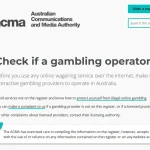
In Australia, ACMA points people towards its website and the national register to find legal gambling products. Its public register can also be used to check whether a wagering service holds a valid Australian licence. That is a meaningful check for services that may lawfully be licensed; it does not turn an online casino ranking into evidence that casino games are authorised for Australian customers. The wording on a page should not blur those categories.
A genuine test of a claim begins with its source. Is the page explaining how it reached its verdict, or merely repeating promotional language? Does it distinguish a service’s own assertions from information that can be checked through an official source? Does it use “safe” to describe a narrow technical feature, or stretch the word until it seems to mean lawful, fair and protected all at once? Those are different questions, and one reassuring answer cannot stand in for the others.
Pokies Open Near Me in Australia: Casino Hours
The same care applies to phrases such as “best safe online casino” or “safe online slots”. They imply a settled category of approved options. In the Australian market, that implication can itself mislead. A site may be accessible, well designed and praised in a review without having permission to provide online casino games to people in Australia. A foreign licence, if claimed, is not an Australian licence. Where a service is unlicensed, consumer protections are absent, and Australian laws may not assist if winnings are withheld.
There is also a difference between a review and an endorsement. A page may receive commercial benefit from directing attention to a service, so confident wording deserves more scrutiny, not less. Disclosures and explanations of how a ranking was made can help readers understand the page’s interests; they do not establish that the casino is authorised. The same goes for user comments and attractive interface design. Popularity is not a legal status.
A claim that a casino is “licensed in Australia” should be checked against the relevant official register, rather than accepted because a logo looks familiar. If the claimed licence cannot be verified there, the claim has failed its most basic test. Nor does a VPN provide a workaround that makes the service safe: using one may lead to winnings being voided, an account being closed and a deposit being lost.
A ranking can organise opinions. It cannot grant permission, create consumer protection or settle a question of safety. A heading is not a safeguard.
Australian Casino Sites and the Limits of a Familiar Label
“ Australian” can describe a website’s audience, its language or the way it presents itself. It does not establish that the business is based in Australia, or that it may lawfully offer online casino games to people here. In this market, the distinction is not a matter of branding. The Interactive Gambling Act 2001 prevents domestic operators from providing online casino games to Australian residents.
Highest Payout Online Casinos in Australia: Explained
That makes “safe Australian casino” an awkward phrase. It can sound like a promise of local oversight while referring only to a site designed to attract Australian customers. An Australian flag in the graphics, familiar expressions in the copy or a page written for local readers cannot change the service’s legal status. Nor does a website become an authorised domestic casino merely because it loads on an Australian device.
The law draws a line around the operator’s conduct, not the appearance of a web page. The Australian Communications and Media Authority, known as ACMA, is the main regulator of online gambling. Where an operator breaches the Interactive Gambling Act, ACMA can block websites and issue fines. A site’s continued presence in search results or its polished presentation is therefore a poor substitute for knowing what kind of service it is.
There is a quiet tension in the phrase “Australian site”: the label suggests familiarity, while the legal framework makes real-money online casino games unavailable as a lawful domestic offering. A service may still direct its marketing towards Australian customers, but that does not make it an Australian casino in the sense that matters. Familiarity is not jurisdiction.
The same caution applies to claims that a site is “safe and secure” or has been reviewed as such. Those phrases can refer to how a website looks or functions; they do not prove that it is licensed in Australia to provide casino games. In this context, no domestic authorisation for such an offering can be inferred from a badge, a localised homepage or an assurance written by the operator itself. A reassuring label remains a label.
Best Casino App for Android in Australia: How It Works
Availability is not approval either. ACMA can block sites that breach the law, so an address that opens at one moment does not establish that the service is permitted to operate here or that access will remain. Using a VPN to reach a casino can also bring practical consequences: winnings may be voided, an account closed and a deposit lost. Circumvention does not turn an offshore service into a domestic one.
The more useful question is not whether a site feels Australian, but what the label is being asked to conceal. If it implies a lawful local casino service, it misleads. If it means only that the page is aimed at Australians, it says nothing about permission to offer the games. In a market where domestic online casino provision is prohibited, the distinction is decisive. Familiar, perhaps. Authorised, no.
Paying and Playing Without Mistaking Access for Approval
A website that loads and accepts a payment can create an impression of ordinary commerce. The page opens; the checkout works; the transaction appears to have found its destination. None of that establishes that the service is authorised to offer online casino games in Australia. A working route is evidence of access, not approval.
That distinction matters because access is not guaranteed to last. ACMA can ask internet service providers to block websites offering prohibited interactive gambling to Australians, as well as unlicensed gambling services for adults. It can also seek a block as a last resort where customer safety is considered at risk. The regulator’s record gives the policy a practical shape: since its first blocking request in November 2019, ACMA has acted to restrict access to 1,369 illegal gambling and affiliate websites.
Since November 2019, ACMA has acted to restrict access to 1,369 illegal gambling and affiliate websites.
A block does not necessarily make a site disappear from every screen or stop every transaction at once. But the possibility of intervention makes a familiar-looking website a poor measure of stability. A service may be reachable at one moment and not at another; a payment route may function without resolving the legal status of the gambling being offered. The checkout is not a licence. It is a checkout.
Nor does a payment brand settle the question. A card, wallet or other route can make a transaction feel recognisable, but the payment method does not confer Australian authorisation on the casino. The same is true of a polished interface or a page styled for local customers. These are features of presentation and access, not evidence that the operator may lawfully provide online casino games to people in Australia.
Using a VPN to reach a casino can add another layer of uncertainty. The site may treat that access as a breach of its own terms, with possible consequences including voided winnings, account closure and loss of the deposit. A tool that changes what appears to be accessible does not change the service’s legal status. It may instead make account access and any dispute harder to resolve.
The practical question behind “safe to pay” is therefore larger than whether a transaction can be completed. It includes whether the service is permitted to operate for Australians and whether access might be blocked. ACMA’s blocking activity is not a payment-security rating, and a successful payment is not an official endorsement. The two systems answer different questions.
Online casino services remain prohibited for Australian customers under the national framework. A site’s ability to take money cannot turn that prohibition into permission. Access can look convincing. Approval is another matter.
Casino Games, RTP and What a Number Leaves Out
A pokie’s return to player, or RTP, is often presented as a compact measure of how a game returns money over time. The number can look more decisive than it is. It describes a game setting, not what will happen in an individual session, and it does not establish that the game or the site offering it is safe.
The RTP information is generally found inside the game itself. An information or help screen may be opened through an “i” symbol or a menu icon. That is a more useful place to check than a promotional description, where a figure can be displayed without making clear which version of the game is running.
There is a reason for that distinction. Some game providers release the same title in several RTP versions, and the operator selects which version to offer. A familiar name, identical graphics and unchanged rules can therefore conceal a different setting. The game’s identity alone does not tell the whole story; the information screen is where the selected version may be stated.
This does not make RTP a safety certificate. It says nothing by itself about whether an online casino is safe, whether its presentation is trustworthy, or whether the service is legally available in Australia. A transparent game screen can answer a narrow question about the game. It cannot answer every question surrounding the place where the game is hosted.
Checking RTP
Return to Player (RTP) information is generally found inside the game itself, accessible through an “i” symbol or a menu icon. This is more reliable than promotional descriptions, as operators may offer different RTP versions of the same game title.
The Australian legal setting makes that separation especially important. Online slots and casino games such as blackjack are illegal when offered to people in Australia. A clearly displayed RTP does not change that status. Nor does access to a free version turn an online casino service into an authorised one; the appearance of a game and the legal position of its provider are separate matters.
That is the limit of the number. RTP can help identify which version of a pokie is being presented, but it is not a verdict on fairness in every sense, and it is not a substitute for understanding the service behind the screen. The label may be precise. The conclusion drawn from it may not be.
A number is not a safeguard.
Mobile Access, Gambling Controls and the Question of Harm
A phone makes gambling easier to fit around ordinary life: a spare moment becomes an account screen, and a screen can travel wherever its owner does. That convenience is not a safety feature. Nor does a smooth login, including through a mobile browser, establish that an online casino is authorised to serve people in Australia.
iPhone Casino Apps in Australia: Browser or PWA?
The law draws a separate line around the service itself. Online casino games cannot lawfully be offered to people in Australia, and responsible-gambling tools do not alter that position. Australian rules place strict responsible-gambling obligations on licensed gambling operators; that is not the same as licensing online casinos for Australian residents. A control on an account cannot turn a prohibited service into a permitted one.
Deposit limits are one kind of control discussed in specialist casino reviews: the descriptions refer to settings for daily, weekly or monthly deposits. That account of a feature should be treated as a report about what a service may offer, not as evidence that a particular casino is licensed in Australia or that the setting works as a safeguard in every circumstance. A limit can put a boundary around deposits; it cannot remove the risks of gambling or settle the legal status of the service.
Mobile access can also make it easier to return to gambling without much pause. Controls matter most when they are understandable and accessible, but their presence on a phone is not proof of meaningful protection. A polished interface can display a limit or a help link while leaving the underlying service outside Australia’s lawful market. Appearance is not jurisdiction.
Reputable gambling platforms provide information about gambling-related harm and direct people to professional support services across Australia. Such information has a different purpose from account controls: it points beyond the platform, towards help that is not simply another feature of the gambling service. Gambling Help Online is one Australian support service. Its role is not to certify a casino.
There is also a practical risk in trying to overcome blocked access. Using a VPN to reach a casino may lead to an account being closed, winnings being voided or deposits being lost. The technology can disguise a connection; it cannot confer approval. A mobile casino that loads is still only a site that loads.
The distinction is easily blurred on a small screen, where access, controls and support may sit together in one interface. But convenience, harm-reduction features and professional help are separate things. None makes prohibited online casino gambling lawful. The screen is not the safeguard.
When a Casino Looks Safe but Has No Australian Protection
A site can look orderly and still leave a player without meaningful protection. Padlock symbols, polished pages and familiar payment screens belong to the technical surface of a service; they do not establish that it is authorised to offer online casino games in Australia or that a player has recourse if something goes wrong.
Casinos use SSL encryption to protect information and transactions as they move between a device and a website. That matters: encryption can help prevent sensitive details from being read in transit. But it cannot establish who controls the site, require an operator to honour a balance, or provide an Australian authority with a route to resolve a dispute. Security of the connection is not security of the relationship.
Most Secure Online Casino in Australia: Legal Limits
The legal position is not symmetrical. Under the Interactive Gambling Act 2001, operators cannot offer online casino games to people in Australia. The law does not explicitly criminalise an individual player for using an offshore casino site. That distinction may sound reassuring, but it does not turn an offshore service into a protected local one.
Where an unlicensed service withholds winnings or closes an account, Australian laws may not assist the player in recovering the money. Consumer protections attached to locally regulated services are absent, and an operator based offshore may be beyond the practical reach of Australian remedies. A website may answer support messages, display encryption credentials and process transactions; none of those features supplies the protection of Australian authorisation.
Nor is a working website proof of approval. ACMA can ask internet providers to block access to prohibited gambling services, so access may change or disappear. A VPN does not repair the legal or consumer-protection gap: using one to reach a casino may lead to voided winnings, account closure and loss of the deposit.
The useful question is therefore not simply whether an online casino is technically safe. It is whether the service can offer Australian protection when the player needs it. In this market, a reassuring interface and an enforceable safeguard are different things. A quiet distinction.
Safe AU Casinos, Australian Dollars and the Licence Question
“AU” in a brand name and “AUD” beside a balance are labels, not credentials. They can signal that a service accepts Australian customers or displays funds in Australian dollars; neither establishes that it is licensed in Australia. Currency is a unit of account, not a regulatory seal.
That distinction matters because the Australian Communications and Media Authority (ACMA) is the country’s main online gambling regulator, but its public register is not a certificate for offshore casino games. Australians are encouraged to use the register to check whether a wagering service holds a valid Australian licence. A casino claiming Australian authorisation should be treated cautiously if that claim cannot be verified there. For online casino games, the local licence label is not a route to approval.
Security checks still have a place, though they answer a narrower question. SSL encryption can help protect transactions and sensitive information as they move between a device and a site. It does not establish who operates the service, whether the service is authorised, or what recourse exists if something goes wrong. A secure connection is a technical measure. Nothing more.
Identity checks are another ordinary part of online accounts. A casino may require identity verification before a withdrawal and request photo identification, proof of address, and evidence that the payment method belongs to the account holder. The process should be explained clearly, including how documents are handled. A vague or shifting request for personal information is a reason to pause rather than send more.
The same caution applies to a wallet advertised for Australian users or an app presented as safe. A familiar payment label, polished interface, or reassuring lock symbol cannot turn a prohibited service into an authorised one. Nor does a discussion on a forum establish that a platform is dependable; individual reports may describe experiences, not regulatory status.
A VPN is no workaround. Using one to reach a casino may lead to winnings being voided, an account being closed, and deposits being lost. The branding may sound local. The protection may not be.
What are the legal consequences for Australian players using offshore casinos?
The Interactive Gambling Act 2001 does not explicitly criminalise individual players for using offshore casino sites. However, that does not make it lawful for an operator to offer online casino games to Australian residents.
What responsible gambling tools and support services are available?
Licensed operators provide deposit limits that players can set daily, weekly or monthly. Reputable platforms also share information about gambling-related harm and direct people to professional support services in Australia.
How long should a withdrawal take from a secure casino?
PayID and some e-wallet withdrawals may be quick once approved, while bank transfers and card withdrawals can take several business days. Identity checks may be required before a withdrawal, and the payment method affects how funds are returned.
Safety

Best Australian Mobile Casinos: Apps and Access
A practical look at browser play, payment options, bonus conditions and the limits of comparing...

Best Casino App for Android in Australia: How It Works
Most Australian mobile casino access happens through a browser, while account terms and the difference...

iPhone Casino Apps in Australia: Browser or PWA?
iPhone casino play in Australia may be a mobile website or a Progressive Web App,...

Best casino apps in Australia: what to know
Australia’s rules turn on the gambling service and the player’s location, not whether it appears...

Best Casino Not on BetStop Australia: What to Know
BetStop is a self-exclusion register, not a casino licence, and its protections do not automatically...

Instant withdrawal casinos in Australia: how payouts work
Mobile casino sites may look like apps, but withdrawal timing can depend on verification, bonus...

International Casinos for Australian Players: Key Limits
The guide separates Australian legal boundaries from practical questions about games, payments, bonuses, mobile access...

Offshore Casinos for Australian Players: How to Assess
A practical look at browser access, licensing limits, legal exposure and the terms that can...

Curaçao Casino Licence for Australian Players
A Curaçao licence identifies an offshore regulatory basis, but does not itself establish permission to...

Highest Payout Online Casinos in Australia: Explained
RTP describes a game's theoretical return over many plays, not a promised result or the...

Inclave Casinos in Australia: Legal Access Explained
The Interactive Gambling Act sets limits on supplying online casino games to people in Australia,...

iPad Casinos in Australia: Access and Legal Limits
The device affects controls and game compatibility, but Australian legality depends on the service being...

Most Secure Online Casino in Australia: Legal Limits
Account safeguards, payment handling and game fairness are distinct from whether an online casino may...

Online Pokies Australia: Real-Money No-Deposit Offers
The guide separates free-play credits from offshore real-money offers and explains how terms and Australian...

Online Pokies E-Wallets in Australia: Payments and Risks
The guide separates operator restrictions from player conduct and explains wallet payments, access checks, withdrawals...

Pokies Open Near Me in Australia: Casino Hours
Major casinos may operate around the clock, but that does not guarantee every area or...

Australian Pokies Parlours: Casinos and Online Claims
A casino’s physical address and local licence matter; familiar parlour language on a website establishes...

Real-Money Pokies on Android in Australia
A practical look at offshore operators, browser and app access, free-play credits, payments and safeguards...

Real Money Pokies Apps in Australia: How They Work
Australian casino access often happens through a mobile browser or a home-screen shortcut, using the...

VPN-Friendly Casinos in Australia: What Access Means
Australia’s rules target operators offering real-money casino games, while a VPN only changes the connection...