Solana Casino Comparison in Australia: Legal Risks
 Available in AU

The guide distinguishes ordinary SOL transfers from offshore casino services and examines payments, bonuses, game costs and withdrawals.
Table of Contents
- The Australian legal line around offshore Solana casinos
- How SOL moves from an Australian account to a casino wallet
- What a meaningful Solana casino comparison can verify
- Slots, bonus funds and the arithmetic of playthrough
- Solana casinos and NFT claims: what the available facts support
- SOL, USDC and the difference between a token and a casino account
- Dice games on Solana: payment fees are not the house edge
- Casino games, bonus conditions and the cost of a wager
- A casino token does not make gambling winnings tax-free
- The withdrawal clock belongs partly to the casino
- Payments
The Australian legal line around offshore Solana casinos
SOL itself is not prohibited in Australia. People may buy, hold and transfer it as a crypto asset. The legal difficulty begins when that asset is used to gamble with an offshore operator: the Interactive Gambling Act 2001 prohibits overseas businesses from providing online casino services to people in Australia. Slots and table games do not become lawful services simply because the stake is sent as a token rather than Australian dollars.
That distinction matters. The Act is directed at the operator offering the service, not at the individual player. Australians are not directly penalised under it merely for using an offshore casino. But the absence of a player penalty is not permission, and it does not make an offshore Solana casino legally safe. A quiet enforcement record, where one exists, would not alter the law.
The law separates the person holding SOL from the business accepting it for casino play. That can make the arrangement feel like an ordinary crypto transaction followed by a private wager. Legally, however, the payment method does not erase the nature of the service. The operator is still offering online casino gambling to someone physically in Australia.
There is no neat local licensing route that turns an offshore casino into an authorised Australian service. A foreign licence, if an operator holds one, does not override the Australian prohibition. Nor does a casino’s use of Solana create a special exemption. The technology may change how value moves; it does not redraw the boundary set by the Act.
For players, the more immediate consequence is practical rather than criminal. Australian law does not provide a reliable route to recover funds if an offshore casino freezes an account or withholds winnings. A dispute may be handled under the operator’s own terms and through its chosen channels, but those arrangements are not equivalent to Australian consumer protection or a local authority able to secure payment. The gap becomes stark at the moment money is disputed.
Under-an-hour casino withdrawals in Australia: how they work
This is the legal grey zone in its proper shape: Australians may lawfully possess and transfer SOL, while the casino service they use is prohibited from being offered to them. The grey wording should not soften the clear part. The operator’s conduct is prohibited; the player is not directly punished for participating; and the player may have no Australian legal protection when the relationship breaks down.
A VPN does not repair that position. It may breach an operator’s terms and can expose an account to seizure or funds to loss; it does not make the service lawful in Australia. Concealing location changes what the platform can see, not what the law says about providing casino games to Australian residents.
The distinction is less elegant than the technology. Tokens travel across borders with little ceremony, while gambling law still asks who is offering the service and where the customer is located. For an Australian considering a Solana casino, the central legal fact is therefore not whether SOL can be transferred. It can. The issue is that an offshore operator is prohibited from providing online casino games to residents, and any money sent into that arrangement sits beyond the protections available through Australian law.
How SOL moves from an Australian account to a casino wallet
Funding an offshore casino with SOL is a two-part journey: Australian dollars first become cryptocurrency, then SOL moves from an exchange account to a wallet address supplied by the casino. The distinction matters. Most Solana casinos do not take AUD directly by bank transfer or card, so the ordinary banking route ends at the exchange, not at the gambling account.
Australian exchanges including Swyftx, CoinSpot and Coinbase AU support AUD deposits through PayID or bank transfer. After depositing dollars, a customer can use the exchange to buy SOL. The exchange account is the point where AUD enters the process; the casino receives SOL, not the original bank payment. That makes the exchange an intermediary, with its own account procedures and identity checks.
Those checks are part of the on-ramp and off-ramp system, not an optional flourish. Services converting between SOL and AUD are subject to KYC and anti-money-laundering requirements. The exchange may therefore ask for identity information when an account is opened or used. Later, converting casino proceeds back into dollars involves the same broader distinction: a crypto balance is not yet money in an Australian bank account.
Attention: Services converting between SOL and AUD are subject to KYC and anti-money-laundering requirements, meaning exchanges may request identity information.
Once SOL is bought, the transfer begins with a destination address. The casino wallet displays an address for receiving funds; the exchange uses that address to send SOL over the Solana network. The address is not a name that can be corrected after the fact. A mistyped or otherwise incorrect destination can mean permanent loss, because blockchain transfers are irreversible. There is no bank-style recall button waiting behind the screen.
Careful copying matters, as does checking that the transfer is being sent on the intended network. A small test transfer can reduce the risk of discovering an address problem only after a larger amount has been sent, although it does not make a mistaken destination recoverable. The transaction details should be reviewed before confirmation, rather than treated as clerical residue.
The network itself is quick. A specialist technical review reports confirmation in roughly 400 milliseconds, with the receiving balance updating immediately. That describes the movement on Solana, not the full time taken to buy SOL, complete exchange checks, or have a casino credit a deposit. The distinction is easily lost in the word “instant”. A fast network can settle a transfer promptly; it cannot make every organisation in the chain equally prompt.
The network fee is also small: the stated average is US$0.00025 per transaction, effectively near-zero. That fee belongs to the transfer, not to the exchange’s conversion process or any other charge a service may apply. A cheap transaction is not the same thing as a cost-free route from AUD to a casino balance. Each stage has its own terms.
There is another cost that does not appear as a line item. SOL’s price moves against currencies such as AUD, so the value of a balance can change between buying the token, playing, and converting any remaining funds back. A nominal SOL win may be worth less in Australian dollars at withdrawal than it was when the SOL was acquired. The network can be fast while the exchange rate changes on a different clock.
Legal Risk
Offshore operators are prohibited from providing online casino services to Australian residents, and players have no Australian legal protection if funds are withheld.
The same exposure applies to funds left in a wallet while a player decides what to do next. A crypto balance records a quantity of SOL; it does not preserve a fixed AUD value. That difference is central to the route, not a technical footnote. The token carries both the payment function and its market price.
Using an offshore casino remains legally unsafe for Australians even where no individual player is directly penalised under the law. Offshore operators are prohibited from providing online casino services to Australian residents, and the absence of a prosecution does not turn the arrangement into a lawful or protected one. Australian authorities cannot provide ordinary consumer recourse if funds are withheld or a platform closes.
Nor should a VPN be treated as a harmless detour around access restrictions: an operator may seize an account and funds if it considers the connection a breach of its terms. Cash-out conditions should be read before any deposit, since larger withdrawals or bonus cash-outs may prompt KYC checks requiring identity documents. The transfer is only one leg of the journey. The return route has its own gatekeepers.
What a meaningful Solana casino comparison can verify
Choosing a Solana casino for Australia means checking the details that matter to your own play, such as payment options and licensing information. Use these operator notes as a reference when comparing the available information.
1. MrPacho
Payout speed: crypto 30-120 minutes, fiat 24-72 hours · Min. deposit: A$30
MrPacho lists crypto payouts at 30–120 minutes and fiat payouts at 24–72 hours. Its minimum deposit is A$30.
2. Rollero Casino
License: Curacao Gaming Control Board OGL/2023/176/0095 (Hollycorn N.V.)
Rollero Casino lists a Curacao Gaming Control Board licence, OGL/2023/176/0095, held by Hollycorn N.V.
3. Neospin
License: Curacao Gaming Control Board OGL/2023/176/0095 (Hollycorn N.V.)
Neospin lists a Curacao Gaming Control Board licence, OGL/2023/176/0095, held by Hollycorn N.V.
4. LevelUp Casino
License: Curacao eGaming OGL/2023/174/0082 (Dama N.V.) · Min. deposit: A$15
LevelUp Casino lists a Curacao eGaming licence, OGL/2023/174/0082, held by Dama N.V. Its minimum deposit is A$15.
5. SkyCrown
License: Tobique Gaming Commission · Payout speed: crypto ~10-15 minutes, fiat 1-5 days · Min. deposit: A$30
SkyCrown lists a Tobique Gaming Commission licence. Its stated payout times are around 10–15 minutes for crypto and 1–5 days for fiat; the minimum deposit is A$30.
6. SpinsUp
License: Curacao Gaming Control Board OGL/2023/174/0082 (Dama N.V.)
SpinsUp lists a Curacao Gaming Control Board licence, OGL/2023/174/0082, held by Dama N.V.
7. Vegaz Casino
License: Curacao OGL/2024/1335/0780 · Min. deposit: EUR 20
Vegaz Casino lists a Curacao licence, OGL/2024/1335/0780. Its minimum deposit is EUR 20.
8. Kingmaker
Payout speed: crypto ~90 minutes, fiat 1-5 days · Min. deposit: A$30
Kingmaker lists crypto payouts at around 90 minutes and fiat payouts at 1–5 days. Its minimum deposit is A$30.
9. WinSpirit Casino
License: Curacao eGaming OGL/2024/923/0383 (Antillephone N.V.) · Min. deposit: A$30
WinSpirit Casino lists a Curacao eGaming licence, OGL/2024/923/0383, held by Antillephone N.V. Its minimum deposit is A$30.
10. Uptown Pokies
License: Curacao (operating since 2017) · Min. deposit: A$20
Uptown Pokies lists a Curacao licence and has been operating since 2017. Its minimum deposit is A$20.
A useful comparison is less a medal ceremony than an audit trail. A polished page can call an offshore site one of the best places to play with SOL; the meaningful question is what evidence supports the description, and what the comparison cannot change. In Australia, that limit is decisive: the Interactive Gambling Act 2001 prohibits offshore operators from providing online casino games to residents. A favourable review does not make the service lawful or legally safe for Australians.
Licensing is one place to begin, but a badge is not evidence by itself. A comparison should identify the regulator said to have issued a licence, link to a record that can be checked, and distinguish a current licence from an operator’s own claim. It should also make clear what that licence does and does not mean for someone in Australia. No specific licensing framework for crypto-gambling operators has materialised in Australia as of mid-2026. A foreign licence does not authorise an offshore casino to offer prohibited services to Australian residents, nor does it create Australian consumer protection if an account is frozen or winnings withheld.
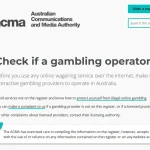
The regulator’s actions are visible in another way. The Australian Communications and Media Authority (ACMA) enforces the Act by blocking unlicensed offshore gambling websites. Its public Gambling Prohibition Register listed over 200 unlicensed gambling sites as of 2026. That register is useful for understanding the scale of enforcement, not for treating every unlisted site as approved. A site can be absent from a list without being lawful, and a comparison table cannot confer permission. No prosecution of an individual player would alter the rule applying to operators or turn offshore play into a legally safe choice.
New PayID Pokies in Australia: How Payments Work
Game information also needs a source. Return to player, or RTP, is meaningful only when tied to the particular game and its published information; a broad site-wide claim is difficult to assess. A comparison should show where the figure comes from and avoid implying that RTP predicts the result of a short session. Even when a stated return can be checked, it describes a statistical feature of a game, not a promise about an individual outcome.
“Provably fair” requires similar care. The label is not a result. A comparison should explain what the site lets users verify, where the verification method is described, and whether the explanation is specific enough to follow. A technical term in a banner does not establish that every game or every outcome can be independently checked. Where the method is not set out clearly, the comparison should say so rather than converting a claim into a finding.
Withdrawal KYC policies belong in the same evidence column. The relevant question is not merely whether a platform says it checks identity, but when checks may occur, what documents may be requested, and whether a withdrawal can remain pending while a review takes place. Larger withdrawals or bonus cash-outs may trigger KYC checks requiring identity documents. Those conditions matter before any deposit: cash-out terms should be read first, not after a balance has become difficult to access. Offshore users have limited consumer protection and no recourse through Australian authorities if funds are withheld or a platform closes.
Do
- Link to a checkable regulator record
- Check the source of RTP figures
- Read cash-out terms before depositing
Don’t
- Trust a license badge alone
- Treat RTP as a guaranteed result
- Rely on a VPN for legal protection
Bonuses are particularly easy to make look larger than they are. Their effective value depends on the playthrough requirement, which games count and at what contribution rate, the time allowed, and any cap on cashing out. A comparison that reports only the headline bonus leaves out the arithmetic that determines whether it can become withdrawable money. The same offer can have different practical value depending on those conditions. Clear treatment means putting the restrictions beside the advertised benefit, not in a distant footnote.
This is how a comparison of Solana casinos can be useful without pretending to certify them. It can separate evidence from advertising, show which terms are documented, and mark what remains an operator’s claim. It cannot make an offshore casino compliant with Australian law, guarantee fair treatment, or supply a remedy when a dispute arises. A VPN does not solve that problem; its use may lead to account seizure and loss of funds. The table may be tidy. The boundary is not.
Slots, bonus funds and the arithmetic of playthrough
Bonus labels can make a slot offer look larger than the balance that can actually be withdrawn. The distinction is between a displayed credit and money cleared for cash-out: winnings from bonus funds must first meet the operator’s wagering conditions. Free spins can carry their own rules, too. A specialist review describes free-spin winnings being credited as bonus funds with a separate wagering requirement, including a 50x condition. That is an example reported for a particular offer, not a standard that can be assumed across offshore casino sites.
Same-day payout casinos in Australia: how timing works
The arithmetic is simple; its consequences are not. A specialist review describes a 40x requirement on a 5 SOL bonus. The player would need to place 200 SOL in qualifying bets before withdrawal. That is turnover, not a bill for that exact amount: bets can return winnings, or lose them. But the same SOL may cycle through wager after wager, while the bonus remains unavailable as cash until the condition is satisfied. The balance on screen is not necessarily the balance in hand.
The wording of a requirement matters as much as its multiplier. A specialist review describes a 35x requirement applying to the bonus alone. A condition applying to the bonus and the deposit would produce a different amount of required play. Terms also determine which games count, whether a maximum cash-out applies and when the offer expires. Those details belong in the calculation before a deposit, not in the small print discovered after a win.
Slots can appear favourable within this arithmetic because they typically contribute 100% of each qualifying wager toward playthrough. Table games such as blackjack or roulette may count for only 10–20%. If a game contributes less, more actual betting is needed to clear the same wagering target. A bonus that seems to require a given turnover can therefore demand substantially more play when wagers fall on lower-contribution games. The nominal multiplier is only half the story.
This is where a slot’s pace can serve the operator’s terms better than the player’s budget. Repeated wagers move a requirement forward, but they also expose the bonus balance to the game’s outcomes. A high contribution rate does not make a slot generous or improve its odds; it only determines how much of a wager is credited toward the condition. Bonus accounting and game fairness are separate questions.
Bonus Playthrough
Calculate turnover
Multiply the bonus amount (e.g., 5 SOL) by the wagering requirement (e.g., 40x) to find the total required turnover (200 SOL).
Check contribution
Verify if the game is a slot (typically 100% contribution) or a table game (often 10–20%), which determines how much of each bet counts toward the target.
Satisfy conditions
Place qualifying bets until the turnover requirement is met before the bonus balance becomes available for withdrawal.
SOL adds another moving part. Its market price can fall between deposit and withdrawal, reducing the Australian-dollar value of any winnings even if the token balance remains unchanged. Transfers are irreversible, so an incorrect wallet address can mean permanent loss. The mechanics are not a reason to treat an offshore offer as safe: the Interactive Gambling Act 2001 prohibits overseas operators from providing online casino games to Australian residents. Fine print cannot alter that line.
Solana casinos and NFT claims: what the available facts support
Solana’s place in casino payments is easier to describe than its supposed place in casino NFTs. The network can move value quickly and at near-zero fees; those properties do not establish that a casino has a working NFT feature, or that an NFT changes how its games or accounts operate.
A specialist review puts Solana transaction confirmation at about 400 milliseconds, with balances updating immediately. The average transaction fee is reported as $0.00025 USD—effectively zero. These are network-level characteristics, not promises about the time a casino takes to approve a payment. Nor do they show that a casino offers an NFT marketplace, uses tokens as access passes, or links digital collectibles to gameplay.
That distinction matters because “NFT casino” can suggest a whole architecture where the evidence supports only a payment rail. An NFT might be presented as a collectible, a membership credential, or an asset with some other role; none of those functions can be assumed from the presence of SOL payments. The label alone is not a description of what a platform does.
EcoPayz Casinos in Australia: What Can Be Verified
The same caution applies to claims that NFTs provide ownership or special rights. A transaction recorded on Solana may be quick and inexpensive, but network performance does not determine what an operator promises, whether a token can be transferred, or what happens if the platform changes or closes. Those questions belong to the specific terms attached to a product. Without verifiable terms and a defined function, an NFT claim remains a claim.
For Australians, the legal context cannot be made to disappear beneath a blockchain feature. The Interactive Gambling Act 2001 prohibits overseas operators from providing online casino games to Australian residents. Solana’s speed and low fees do not alter that position, and an offshore casino is not legally safe merely because a player has not heard of anyone being prosecuted. Australian law offers no recourse if such an operator withholds funds or shuts down.
The practical risks remain ordinary, despite the newer vocabulary. SOL transfers cannot be reversed; sending funds to the wrong address means permanent loss. The value of winnings held in SOL can also fall between deposit and withdrawal. Larger withdrawals or bonus cash-outs may prompt KYC checks, and using a VPN may lead to an account being seized and funds lost. Cash-out conditions need to be read before any deposit, not after a balance has become difficult to retrieve.
NFT language can make a casino sound more like a technology product than a gambling service. The underlying distinction is less glamorous: a fast ledger can settle a transfer, but it cannot establish the value of a casino feature or protect a customer from the operator. A quick transaction is still only a quick transaction.
Solana’s network-level characteristics, such as 400ms confirmation times and near-zero fees, do not guarantee the speed of a casino’s internal payment approval process.
SOL, USDC and the difference between a token and a casino account
A casino balance denominated in crypto can look like money on a screen, but it remains a record of what the platform says is available to wager or withdraw. The token itself is a separate asset, held and transferred through the Solana network. The distinction matters when play is conducted in SOL: a balance can rise or fall in Australian-dollar value even when its number of tokens does not change.
A specialist review reports that some Solana casinos accept USDC on Solana for deposits and play as well as SOL. That choice changes the token used for transactions; it does not turn an offshore casino account into an Australian bank account or alter the nature of gambling proceeds. Nor does a crypto label settle the tax treatment.
The Australian Taxation Office treats cryptocurrency as an asset for capital gains tax purposes. Profits from gambling with SOL are therefore subject to Capital Gains Tax. In practical terms, the gambling result and the movement in the asset’s value are not the same thing: a casino may show a winning balance in SOL, while SOL’s value against the Australian dollar changes between the wager and any later disposal. A favourable game result can thus sit beside an unfavourable currency movement.
That is one reason a token is not simply a chip with a fashionable name. Chips represent a stake within a game; crypto also has a value and an asset status outside the casino. USDC on Solana may avoid some exposure to SOL’s price movement, but the denomination alone does not make winnings tax-free or determine how a particular transaction will be treated.
Online Casino Payment Methods for Aussies
SOL’s volatility can reduce the Australian-dollar value of winnings between deposit and withdrawal. The same market movement can affect the value of funds held for play, independently of whether the casino account shows a gain. And a transfer sent to the wrong address is irreversible: the network does not provide a cashier’s counter for retrieving it.
Crypto makes the casino ledger portable. It does not make the ledger the whole story.
Dice games on Solana: payment fees are not the house edge
A dice game may look unusually simple: a wager, a result, and a displayed payout. Solana can make the payment leg of that arrangement inexpensive. Its average transaction fee is $0.00025 USD, a near-zero cost for moving a transaction across the network.
That figure belongs to the network, not the game. It does not describe the casino’s margin, the chance of winning, or whether a result can be independently checked. A small payment fee can sit beside unfavourable odds just as easily as favourable ones; the two costs are separate. The blockchain settles transfers. It does not, by itself, certify the rules or fairness of a dice game.
For a dice casino on Solana, the meaningful evidence would therefore concern the game’s stated odds and how outcomes are generated and verified—not the cost of sending SOL. A low network fee can make repeated wagers feel frictionless. That is a feature of the plumbing, not a reason to assume the arithmetic has become kinder.
Network Fees
Low Solana transaction fees relate only to the network plumbing and do not affect the game’s house edge or fairness.
There is also a distinction between a displayed balance and money that can be recovered. SOL transfers are irreversible: if funds are sent to the wrong address, they are permanently lost. And SOL’s price can change between a deposit and a withdrawal, reducing the value of winnings in Australian dollars even when the token amount has not changed. The network is quick at its own task. The rest is another matter.
In Australia, the Interactive Gambling Act 2001 prohibits offshore operators from providing online casino games to residents. The law targets operators rather than directly penalising individual players, but that does not make an offshore casino legally safe. Australian players have no legal protection if an operator withholds funds or closes. ACMA blocks unlicensed offshore gambling websites; access is not the same thing as approval.
The fee, then, is the least revealing number in a dice wager. It says what the network charges to process a transaction. It says nothing about the wager’s chances, the operator’s conduct, or the value ultimately returned. Cheap machinery. Unchanged uncertainty.
Casino games, bonus conditions and the cost of a wager
A casino bonus is not simply extra balance. Winnings generated from bonus funds must be wagered with real money before they can be withdrawn, so the terms determine how much qualifying play stands between a displayed balance and cash-out. The game chosen can change that amount sharply.
Casinos That Accept PayID in Australia: What’s Verified
Contribution rates measure how much of a wager counts towards the requirement. Slots typically count in full, while table games such as blackjack or roulette may count for only 10–20%. A wager on a table game can therefore move the requirement forward much more slowly than the same-sized wager on a slot. The screen may show activity; the bonus counter may barely notice.
That difference makes game choice part of the price of accepting a bonus. A player drawn to table games could face substantially more play to clear the same condition than someone playing a game with full contribution. The nominal bonus alone tells little about its practical value. Contribution rules, eligible games and the requirement’s basis all matter; a condition calculated on bonus funds is not the same as one calculated on the bonus and deposited funds.
The broader category of Solana casino games does not change this arithmetic. A game’s connection to a blockchain or its payment currency does not, by itself, alter how the operator counts wagers. Bonus terms do that. Nor does a higher contribution mean a game is more favourable: it describes progress towards a condition, not the odds or likely outcome of play.
There is a further distinction between having funds available to wager and having money available to withdraw. Bonus-linked winnings remain subject to the stated wagering conditions, and a balance that includes them is not necessarily cashable. Reading the terms before depositing is more useful than discovering the rules after a win.
In Australia, the Interactive Gambling Act 2001 prohibits offshore operators from providing online casino games to residents. A bonus comparison cannot make such play legally safe. The conditions may be legible; the legal position remains plain.
Attention: Table games often have lower contribution rates (10–20%) than slots, meaning substantially more betting is required to clear the same bonus wagering target.
A casino token does not make gambling winnings tax-free
A casino balance can be displayed in SOL, another cryptoasset or a platform’s own token. That denomination does not settle the Australian tax question. The relevant distinction is between recreational gambling winnings and changes in the value of a cryptoasset.
Recreational gambling winnings are generally not taxable in Australia. Cryptocurrency, however, is treated by the Australian Taxation Office as an asset for capital gains tax purposes. Profits from gambling with SOL are subject to capital gains tax, so a win recorded in SOL cannot simply be treated as tax-free because it came from a game.
This creates two questions that can sit beside each other: whether a gambling win is taxable as gambling income, and whether a gain involving SOL has capital gains tax consequences. A casino token does not erase the second question. Nor does converting a balance from SOL into a different token, or displaying it in a casino account, by itself make the underlying tax distinction disappear.
The word “profit” can sound straightforward in a casino interface. Tax treatment is less tidy. The value of SOL can change, and the Australian tax position concerns the cryptoasset as well as the gambling activity. A balance shown as a number on a screen is not a separate tax category merely because the casino gives it a label.
Real Cash Online Pokies Australia: Bitcoin Explained
Losses are not a general counterweight. A specialist tax review describes gambling losses as offsettable against gains only where the player is regarded as a professional gambler, a status with a high threshold. Recreational play does not become professional activity simply because it is frequent, uses a crypto wallet or involves a casino token. The distinction is narrow, not a convenient way to net losses against winnings.
That is why claims that a token makes play tax-free deserve particular care. A platform may call a unit a casino token, but the name does not decide how the ATO treats cryptocurrency or whether gambling activity is recreational or professional. The same caution applies to promotional rankings of Solana casinos: a position in a “top” list says nothing about a player’s tax status.
The tax treatment depends on the nature of the activity and the cryptoasset involved, not the wording on a casino balance. Keeping records of transactions and obtaining advice on individual circumstances may help clarify obligations. The label is not the law.
The withdrawal clock belongs partly to the casino
A Solana transaction can confirm quickly, but that is only the network’s part of a cash-out. The casino must first approve and send the withdrawal; its internal queue, review process and network congestion can all add time. A specialist review reports processing ranges from 5–15 minutes for automated operators to as long as 72 hours when withdrawals are handled manually. These are not promises for any particular platform.
Payments & Withdrawals for Australian Casinos
The advertised network speed therefore says little about when funds will leave a casino balance. Some casinos also impose a withdrawal fee. One specialist review puts reported charges at 0.1% to 1% of the amount, so the fee schedule matters alongside the stated processing time.
KYC checks can interrupt the clock, particularly for larger withdrawals or cash-outs involving bonus funds. A request for identity documents may mean a withdrawal remains pending while the casino reviews them. Cash-out terms and KYC conditions belong before a deposit, not after a win.
There is a more basic risk. SOL transfers are irreversible: funds sent to the wrong address are permanently lost. SOL’s price can also fall between deposit and withdrawal, reducing the winnings’ value in Australian dollars even if the token amount is unchanged.
Offshore operators are prohibited under the Interactive Gambling Act 2001 from providing online casino games to Australian residents. Using one is not legally safe merely because a player has not been prosecuted. If an account is frozen, winnings withheld or the platform closes, Australian users have no legal protection or recourse through Australian authorities. A fast network cannot repair that gap.
Is it legal to use Solana casinos in Australia?
Australians may legally buy, hold and transfer SOL, but overseas operators are prohibited from offering online casino services to Australian residents under the Interactive Gambling Act 2001. The Act targets operators rather than players, and Australians using offshore casinos may have no Australian legal protection if funds are frozen or winnings withheld.
Are Solana casino winnings taxed in Australia?
Winnings from recreational gambling are generally not taxable in Australia. However, cryptocurrency is treated as an asset for capital gains tax purposes, and profits from gambling with SOL may be subject to CGT.
What fees, limits, and speeds apply to SOL casino deposits?
The average Solana transaction fee is about US$0.00025, and transfers confirm in roughly 400 milliseconds. Minimum SOL deposits typically range from 0.01 to 0.1 SOL, approximately AUD$2.80–$28 at April 2026 prices.
How does a Solana casino work?
You generally buy SOL with AUD through an Australian exchange, then transfer it to the casino’s wallet address to fund your account. Transfers on Solana are fast and irreversible, so check the address and network before sending.
What is the minimum deposit for a Solana casino?
Minimum deposits typically range from 0.01 to 0.1 SOL, approximately AUD$2.80–$28 at April 2026 prices.
Can I deposit other cryptocurrencies at a Solana casino?
Some Solana casinos also accept USDC on the Solana network, so deposits may not be limited to SOL.
Are Australian Crypto Casinos Safe?
Offshore crypto casinos do not come with reliable Australian legal protection if they freeze an account or withhold winnings. A foreign licence does not override Australia’s prohibition on offshore operators providing online casino services to Australian residents.
Payments

Anonymous Crypto Casinos in Australia: Law and Risks
The guide separates operator restrictions from player status and explains the limits of anonymity, crypto...
Aristocrat Online Pokies in Australia: What’s Known
Brand attribution, game details and access are distinct questions, especially when comparing free play with...

Aussie Crypto Casinos: Rules, Payments and Risks
This guide distinguishes offshore crypto sites from Australia's licensed market and examines payment limits, promotions,...

New Australian Online Pokies: What the Law Allows
A cautious guide to offshore licences, account access, payment details and the limits of claims...

Online Casino Payment Methods for Aussies
Payment options can differ between deposits and withdrawals, and offshore casino payment pages are not...

Best Paying Online Pokies in Australia: What to Check
In Australia’s offshore casino market, payout claims need context: game results, bonus conditions and payment...

Bitcoin Pokies in Australia: Payments and Risks
A practical explanation of wallet transfers, casino crediting, Bitcoin value and the checks that can...
Casino Sites That Accept Amex in Australia: A Guide
Amex acceptance does not establish local authorisation, and deposits, withdrawals, fees and game access can...

Casino Sites That Accept BPAY in Australia: What to Know
BPAY availability depends on each operator and transaction purpose; general Australian payment habits cannot verify...
Credit Card Casino Sites in Australia: Amex and Rules
Card acceptance varies, and a payment option does not change the Australian rules governing real-money...

EcoPayz Casinos in Australia: What Can Be Verified
The article distinguishes payment-method mentions from confirmed availability, transaction use and the legal context for...

Casino Sites and Osko in Australia: What’s Known
Osko familiarity does not establish that a particular casino accepts it or supports it for...

Paysafecard Casinos in Australia: What Is Verified
A service’s availability to Australians and its support for Paysafecard are separate claims, and neither...
Casino sites that accept Skrill in Australia: what is known
A Skrill mention does not establish Australian availability, account eligibility or a confirmed withdrawal route....
Trustly Casino Sites in Australia: What Is Confirmed
The article separates general bank-linked payment habits from confirmed casino acceptance and considers the limits...

No-Verification Casino Withdrawals in Australia
Registration may be quick, but casino withdrawals involve identity checks, payment processing and, in some...
Casinos That Accept Apple Pay in Australia
Everyday wallet use and casino payment options are separate questions, and a displayed payment method...

Casinos That Accept Bitcoin in Australia: Legal Context
Bitcoin describes how a casino handles payment, while the operator and its games remain subject...

Casinos That Accept Bitcoin Cash in Australia
A practical overview of BCH casino payments, game access and why a crypto option does...

Casinos That Accept CashtoCode in Australia: What’s Known
The guide separates Australia's rules for offshore casino operators from unverified claims about CashtoCode deposits,...

Casinos That Accept Ethereum in Australia
Ethereum is considered as a payment route, with attention to unverified operator details and the...
Casinos That Accept Google Pay in Australia: What to Know
Australian use of mobile wallets is widespread, but it does not verify casino deposits, withdrawals,...
Litecoin casinos in Australia: legal limits and claims
Australian rules focus on services offered to people in the country, while currency and offshore...
Casinos That Accept Mastercard in Australia: What to Know
A clear look at what Mastercard acceptance claims can establish—and what they cannot show about...

Casinos That Accept MiFinity in Australia: What’s Known
MiFinity listings do not establish that a casino lawfully serves Australian players or supports deposits...
Casinos That Accept Neosurf in Australia: What to Check
Neosurf availability can vary by operator, customer and location, while deposit support alone says nothing...

Casinos That Accept Neteller in Australia
Neteller’s general identity as a payment service does not establish that a casino accepts it...
Casinos That Accept PayID in Australia: What’s Verified
The available evidence reports Amex deposits at some Australian online casinos, but does not confirm...

Casinos That Accept PayPal in Australia: What to Check
PayPal’s everyday use does not establish casino acceptance; payment availability, withdrawals and bonus terms require...

POLi Casinos in Australia: What Can Be Verified
POLi references do not confirm deposit or withdrawal options, and an Australian-facing site is not...

Tether USDT Casinos in Australia: Legal Context
Tether availability does not establish that an online casino is lawful, independently verified or supported...

Casinos That Accept Visa in Australia: What to Know
Visa acceptance may be broader than Amex, but it does not confirm that a particular...

Dragon Link Online Pokies in Australia: What’s Verified
The name alone does not confirm a game, Australian availability, official support or the terms...

Easy Withdrawal Casinos in Australia: How Cashouts Work
Withdrawal timing depends on both the casino’s review and the payment route that carries released...

Fast Withdrawal Casinos in Australia: Payment Routes
The route a payment takes is only part of the picture: casino processing, verification and...

Instant Bank Transfer Casinos in Australia: How It Works
A clear look at PayID, bank-transfer deposits and withdrawals, and the Australian legal context for...

Instant PayID Withdrawals in Australia: What to Know
PayID can move released funds in real time, but casino checks and approval happen before...

Instant PayID Withdrawals for Real Money in Australia
PayID can move an authorised transfer in real time, but casino review, withdrawal checks and...

New PayID Pokies in Australia: How Payments Work
Learn how PayID links an identifier to a bank account, how NPP transfers work, and...

No-KYC Casino Australia: Crypto and Withdrawals
The guide distinguishes cryptocurrency transfers from casino processing and examines what no-KYC claims mean when...

Online pokies instant withdrawals in Australia
Withdrawal timing can involve an operator review before funds are released, followed by the transfer...

Online pokies with PayID in Australia: how payments work
PayID can identify an account through a phone number or email, but it does not...

Pay by phone casinos in Australia: PayID explained
PayID uses a mobile number as a banking identifier, while the deposit itself comes from...

Quick Withdrawal Casinos in Australia: How Payouts Work
A withdrawal depends on both the operator’s approval and the payment route, so a quick...
Real Cash Online Pokies Australia: Bitcoin Explained
Bitcoin’s role as a payment method is distinct from the game itself, while free play...

Safe Online Pokies in Australia: Legal and Payment Risks
Australian law, offshore licensing, Bitcoin payments, verification and bonus conditions all shape the risks around...

Same-day payout casinos in Australia: how timing works
A withdrawal can involve operator review, approval and a separate payment transfer, so the claim...

Under-an-hour casino withdrawals in Australia: how they work
A withdrawal has two stages: operator approval first, then the payment network’s transfer of released...