SpinKing Reviews and Complaints Australia: What the Evidence Shows
 Available in US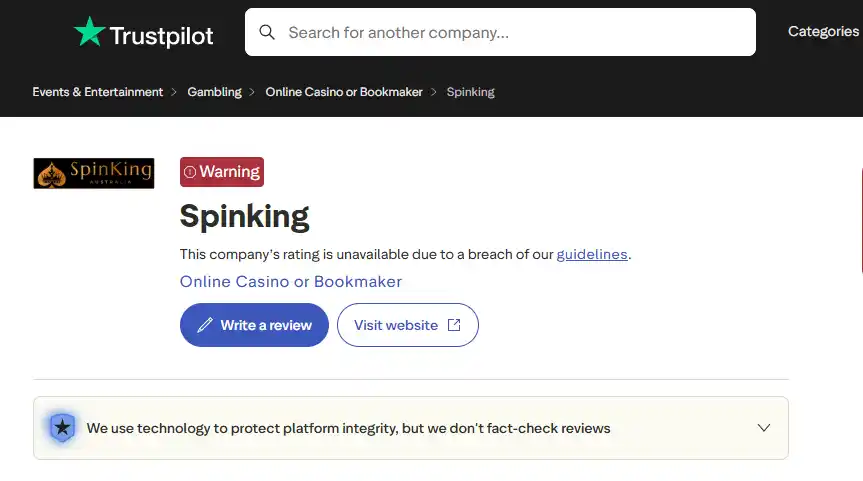
SpinKing reviews need to be read with more care than a normal star-rating page. On 10 September 2026, Trustpilot showed 42 reviews for spinking.net in the last 12 months, with 69% at one star, but it also made the company’s rating unavailable because of a guideline breach and said it had removed fake reviews. That platform warning is a verified fact about the Trustpilot profile. The individual deposit, withdrawal and account stories on the page are user allegations, not verified SpinKing rules.
Casino Guru provides a different evidence layer. Its SpinKing review, updated June 2026, currently shows a 2.5/10 “Very low” Safety Index and publishes warnings about missing General Terms and Conditions, prior fake-game detection and licence claims that Casino Guru labels fake. Those are Casino Guru’s findings under its own methodology, not Australian regulator findings. The useful conclusion is therefore not to average the sources into one score, but to understand what each source can and cannot establish.
Table of Contents
- Current SpinKing review snapshot
- Why Trustpilot’s warning matters more than the raw star mix
- What Australian complaint themes are visible
- Withdrawals: complaints versus verified mechanics
- How to read account-restriction stories
- Casino Guru uses a different methodology
- Why Trustpilot and Casino Guru can disagree without either being useless
- How much weight should an Australian reader give each source?
- A practical complaint-reading checklist
- Bottom line on SpinKing reviews in Australia
- SpinKing review questions answered
- Is SpinKing Legit? Trust, Ownership and Safety Signals for Australia
Current SpinKing review snapshot
| Source | Current signal | What it can support | What it cannot prove |
|---|---|---|---|
| Trustpilot | 42 reviews in the last 12 months; 69% one-star; rating unavailable after a guideline breach; fake reviews removed | The current state of the Trustpilot profile and the presence of recurring complaint themes | That every remaining review is true or that a complaint describes a universal payout rule |
| Casino Guru | Safety Index 2.5/10, “Very low”, updated June 2026 | Casino Guru’s expert-review judgement using its published methodology | An Australian licence decision, court finding or guarantee about a specific transaction |
| ACMA register | No SpinKing or spinking.net match found in the current licensed-provider register check | That no Australian local licence was verified in the register checked on 10 September 2026 | The truth of individual customer complaints or the status of any claimed foreign licence |
For the broad product picture rather than reputation evidence alone, start with the full SpinKing Australia guide.
Why Trustpilot’s warning matters more than the raw star mix
The most important Trustpilot signal is not 69% one-star or 24% five-star. Trustpilot itself currently marks the Spinking profile with a warning that the company’s rating is unavailable because of a breach of its guidelines. The same profile states that a number of fake reviews were removed. Those notices change how the remaining star distribution should be interpreted.
A star mix assumes that the review pool is a reasonably clean sample of genuine experiences. Once the platform itself says manipulation occurred, the aggregate becomes harder to use as a simple reputation score. The warning does not mean every positive review is fabricated, and it does not mean every negative review is genuine. It means the review environment has an integrity problem that should reduce confidence in headline averages.
That is why this page does not create a replacement “trust score” from Trustpilot percentages. A platform-level integrity notice is stronger evidence about the quality of the review dataset than any single five-star or one-star post. The SpinKing trust review places this signal beside licensing, terms and game-integrity evidence without collapsing them into one label.
What Australian complaint themes are visible
Current Trustpilot reviews from users identifying themselves as Australian repeatedly describe three broad types of problem: deposits that users say were debited but not credited to the casino account, withdrawals that users say remained pending or were rejected, and account or transaction reviews that users say resulted in restrictions or delays. Several posts also criticise repetitive or unhelpful support responses.
These patterns are useful for deciding what evidence a reader should preserve if a dispute arises. They are not proof that SpinKing applies a hidden universal rule or that every Australian customer will encounter the same outcome. Reviewers can misunderstand transaction timing, omit context, exaggerate, or describe genuine problems that affect only particular accounts. Trustpilot’s own fake-review warning adds another reason not to convert a complaint pattern into a factual claim about all withdrawals.
There are also positive reviews on the same profile. Some reviewers praise game choice, support or transaction experience. Their existence matters because a balanced source reading should not discard favourable posts while treating unfavourable posts as automatically verified. The integrity warning applies to the review environment as a whole, not only to whichever side supports a preferred conclusion.
Withdrawals: complaints versus verified mechanics
Withdrawal complaints are the most sensitive area because they can sound like operational rules when repeated without attribution. A review claiming that a withdrawal took a certain number of hours, required a particular check or was rejected after a win describes that reviewer’s account. It does not establish the casino’s standard processing time, withdrawal limit, fee schedule or rejection policy.
This site’s evidence set verifies only the narrower point that identity or security verification can be required around withdrawals and account reviews. The current Trustpilot page includes SpinKing replies saying that some transactions, withdrawals or account activities can undergo additional verification, security or compliance checks. Exact KYC documents and exact processing times remain unsupported by primary SpinKing terms or a directly accessible verification screen, so this page does not invent them.
If the decision question is how cash-out processing works rather than what reviewers allege, use the separate SpinKing withdrawals evidence page. It keeps current payment facts apart from anecdotal complaints and blocks exact high-risk terms that cannot be primary-verified.
How to read account-restriction stories
Some Trustpilot reviewers say their accounts were restricted, deactivated or subjected to review around withdrawals. SpinKing replies visible on the same profile refer in general terms to verification, security or compliance checks for certain account activities. That supports the existence of review processes, but not the factual accuracy of either side in a particular dispute.
A reader evaluating such a complaint should separate four questions. First, what did the user claim happened? Second, what did the company reply? Third, is there primary evidence such as an account-status screen, transaction record or current terms clause? Fourth, does the claim describe an isolated dispute or a rule applied to everyone? Only the first two are visible from the review page itself.
The practical value of this distinction is that it prevents an allegation from becoming a fake term. For account creation and the limited verification facts that are actually supported, see the SpinKing registration page. It does not publish exact document lists, password rules or verification timelines that the source set cannot verify.
Casino Guru uses a different methodology
Casino Guru’s SpinKing page currently shows a Safety Index of 2.5/10 with the verbal label “Very low”. Unlike Trustpilot, that number is not an average of SpinKing user star ratings. Casino Guru explains that its Safety Index draws on its review methodology, including terms, complaints, blacklists and other factors. Its SpinKing page says no General Terms and Conditions were publicly available when assessed and lists several negative factors.
The current Casino Guru page also warns about fake games and says SpinKing had previously been detected switching between real and fake games. At the same time, its game-check section says a selection of games was checked and no fake games were found in that selected sample. Both statements matter. Repeating only the historical warning would overstate what the current checked sample shows, while repeating only the clean sample would erase the reviewer’s historical concern.
Casino Guru also labels displayed PAGCOR and Curaçao licence entries as “Fake” on its SpinKing review. This site preserves that as an explicitly attributed Casino Guru warning, not as an independent regulator finding. Australian local licence status is a separate question handled through ACMA and explained on the SpinKing Australian licence page.
Why Trustpilot and Casino Guru can disagree without either being useless
The two sources collect different kinds of evidence. Trustpilot is primarily a consumer review platform. It can show what users publish, how a company replies, and whether Trustpilot has applied an integrity warning to the profile. Casino Guru is an expert review site that applies its own methodology and also runs a complaint-resolution system. A difference between their outputs is therefore expected rather than automatically contradictory.
Casino Guru currently says its user-feedback database has insufficient data for a user score, while Trustpilot has dozens of reviews. That does not mean one platform proves the other wrong. It means their datasets and collection mechanisms differ. Likewise, Casino Guru’s Safety Index is not directly comparable with a Trustpilot star distribution because the inputs and purpose are different.
The disagreement itself is informative. When one source contains many complaints but also carries a manipulation warning, while another publishes a poor expert score for reasons that include terms and integrity concerns, the responsible response is to inspect the underlying evidence categories. Averaging the numbers would create a false sense of precision.
How much weight should an Australian reader give each source?
| Question | Highest-value source | How to use reviews |
|---|---|---|
| Is SpinKing locally licensed in Australia? | ACMA’s current licensed-provider register | Do not use user reviews to answer a licensing question |
| What happened to one person’s deposit or withdrawal? | Transaction records, account screens, current terms and support evidence | Use the review as an allegation or lead, not the final proof |
| What is the state of the Trustpilot profile? | Trustpilot’s own current warning and review page | Give the platform warning more weight than a raw star average |
| What does Casino Guru conclude? | Casino Guru’s current review and methodology | Attribute its score and warnings to Casino Guru |
| Are complaint patterns worth investigating? | Multiple dated reports plus primary evidence where available | Look for recurring themes without assuming they establish a universal rule |
No Australian local licence was verified for SpinKing in the ACMA register check on 10 September 2026. That is a regulatory fact, not a conclusion drawn from bad reviews. Keeping those evidence types separate is especially important in a market where provider-side online casino rules are not the same thing as review-site reputation.
A practical complaint-reading checklist
- Check the date. Review-platform counts, warnings and percentages can change quickly.
- Identify whether the statement comes from Trustpilot, the reviewer, SpinKing’s reply, Casino Guru or a regulator.
- Separate transaction allegations from verified terms. A user’s timeline is not an official processing-time rule.
- Look for corroborating primary material such as cashier records, account messages or current terms before treating a disputed detail as established.
- Do not infer fraud, theft or guaranteed non-payment from a group of complaints.
- Do not infer safety from positive reviews alone, particularly when the platform has issued a review-integrity warning.
This approach is slower than reading the star bar, but it produces a more decision-useful picture. It also avoids repeating the most serious language used by private reviewers when the evidence does not independently support it.
Bottom line on SpinKing reviews in Australia
The current reputation evidence is materially negative but needs disciplined interpretation. Trustpilot shows a strong one-star skew and multiple Australian complaints about deposits, withdrawals and account reviews, while also displaying a guideline-breach warning and saying fake reviews were removed. That makes the complaint themes worth investigating but makes the aggregate rating environment less trustworthy.
Casino Guru separately gives SpinKing a 2.5/10 “Very low” Safety Index and continues to publish significant warnings under its own methodology. Those warnings deserve attention, especially because they concern terms, game integrity and displayed licence claims, but they remain Casino Guru’s attributed findings rather than Australian regulator determinations.
For an Australian reader, the safest way to use these sources is as a map of questions to verify, not as a substitute for primary evidence. Review-platform integrity notices, current account records, official terms where available and regulator registers each answer different questions. No single complaint proves a system-wide payout practice, and no positive testimonial cancels a platform warning.
SpinKing review questions answered
What does Trustpilot currently show for SpinKing?
At the 10 September 2026 check, the spinking.net profile showed 42 reviews in the last 12 months and 69% at one star. Trustpilot also made the rating unavailable due to a guideline breach and said it had removed fake reviews.
Does a one-star complaint prove SpinKing does not pay withdrawals?
No. It is a user’s account of an experience. It can identify an issue to investigate, but it does not establish a universal withdrawal rule or prove what happened in every transaction.
What is SpinKing’s Casino Guru Safety Index?
Casino Guru currently shows 2.5/10 with the label “Very low” in its June 2026 review. The number is Casino Guru’s own expert-review assessment, not an ACMA rating.
Does Casino Guru currently warn about fake games?
Yes. Casino Guru retains a fake-games warning and says fake games were detected previously, while also saying a checked selection of current games contained no fake games. Both parts of that attributed finding should be read together.
Why not name reviewers or repeat their strongest accusations?
The useful information is the recurring complaint theme, not the identity of a private reviewer or inflammatory wording that has not been independently verified. This page summarises patterns and keeps allegations attributed.